Links are not yet activated.
Is this your press release? Add a link to submitpr.org on your website and verify it — activation is instant and free.
Or upgrade with KIN for permanent activation (from $19.95).
INDONESIA, 26 October 2026 – A research article titled "Upaya Literasi Digital dalam Membangun SDM Unggul pada SMPN 7 Amarasi Barat di Desa Tooboun, Amarasi Barat, Kupang, NTT" (Digital Literacy Efforts to Build Strong Human Resources at SMPN 7 Amarasi Barat, Tooboun Village, Kupang, East Nusa Tenggara) examines low media literacy in a remote part of East Nusa Tenggara (NTT), Indonesia. Written by Herlina JR Saragih, Suhirwan and Riza Mahardika of Universitas Pertahanan Indonesia (the Indonesia Defense University), the article was published in Jurnal Representamen Vol. 6 No. 01 in April 2020.The study uses a descriptive qualitative method. Data were collected in two steps: describing the daily activities of NTT communities, then fieldwork in which respondents were asked questions. The population was all students of the state junior high school in Tooboun village, West Amarasi. To assess media literacy, the authors drew on the European Commission's Individual Competence Framework (2009), which covers technical skills, critical understanding and the ability to communicate through media.
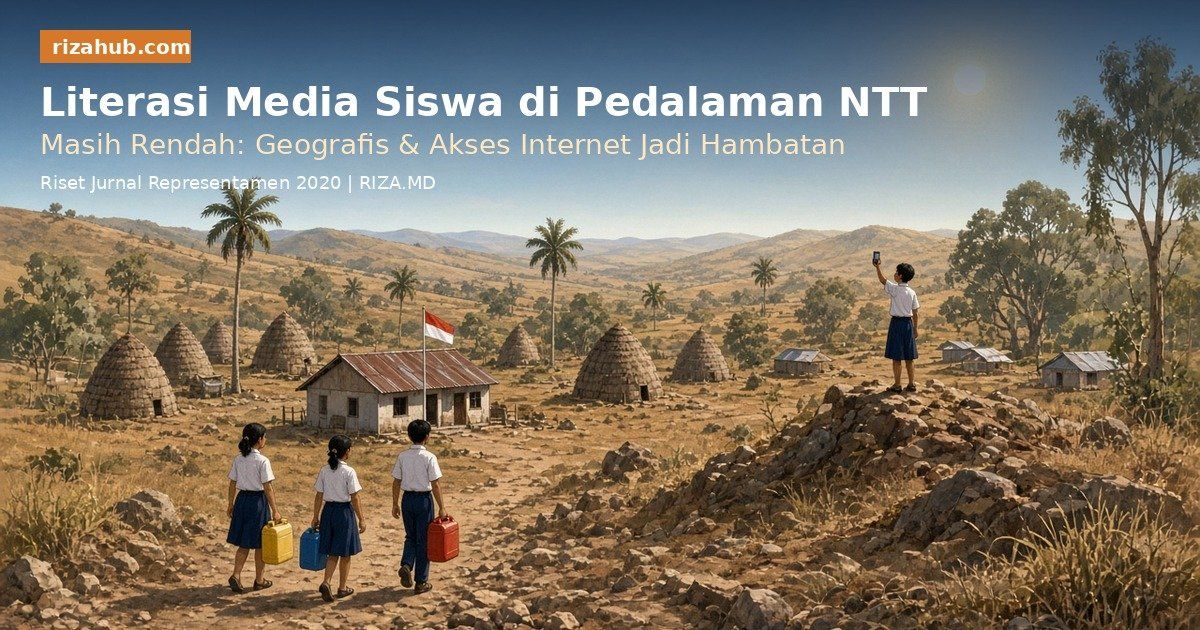
The article describes NTT as a region that is hard to reach, hot, dry, hilly and rocky, with poor soil and scarce mobile signal and internet coverage. Citing the NTT regional planning agency (Bappeda NTT, 2009), it notes that the province has a semi-arid climate, with a rainy season of only three to four months and a dry season of eight to nine months.
According to the authors, a culture of literacy has not yet taken root in NTT communities. Reading and writing are not yet habits, and people watch or listen more often than they read. People also spend an average of three to four hours a day on their phones, which leaves them exposed to unclear information and even hoaxes because they tend to skim rather than read closely.
The study identifies several reasons for students' limited understanding of media literacy: geography and the difficulty of getting clean water; many homes that are inadequate and far apart; few homes with internet access apart from large offices; and damaged school buildings that disrupt teaching. The article concludes that language comprehension and media literacy among students in eastern Indonesia are low.
As solutions, the authors recommend systemic reform in education, broad opportunities for teachers to develop their competence according to their interests and talents, curriculum development training, and the provision of books, classroom facilities and learning media for students.
"Media literacy is not only the ability to read and write, but also the ability to think critically so that people can communicate effectively," said Riza Mahardika, S.Sos., M.Med.Kom. "In places like West Amarasi, geography, internet access and school facilities hold students back. Everyone connected to students has a role to play, according to their capacity."
Notes to Editors
About the article: Herlina JR Saragih, Suhirwan and Riza Mahardika (Universitas Pertahanan Indonesia), "Upaya Literasi Digital dalam Membangun SDM Unggul pada SMPN 7 Amarasi Barat di Desa Tooboun, Amarasi Barat, Kupang, NTT", Jurnal Representamen Vol. 6 No. 01, April 2020 (in Indonesian). Keywords: NTT society, media literacy, socio-cultural values.
About Riza Mahardika: Riza Mahardika, S.Sos., M.Med.Kom. is a communication researcher and digital strategist, and the founder of RizaHub (https://rizahub.com).
Media Contact
Riza Mahardika, S.Sos., M.Med.Kom.
Email: magisteriza@gmail.com
Website: https://rizahub.com