Links are not yet activated.
Is this your press release? Add a link to submitpr.org on your website and verify it — activation is instant and free.
Or upgrade once for permanent activation (from $19.95, pay with crypto).
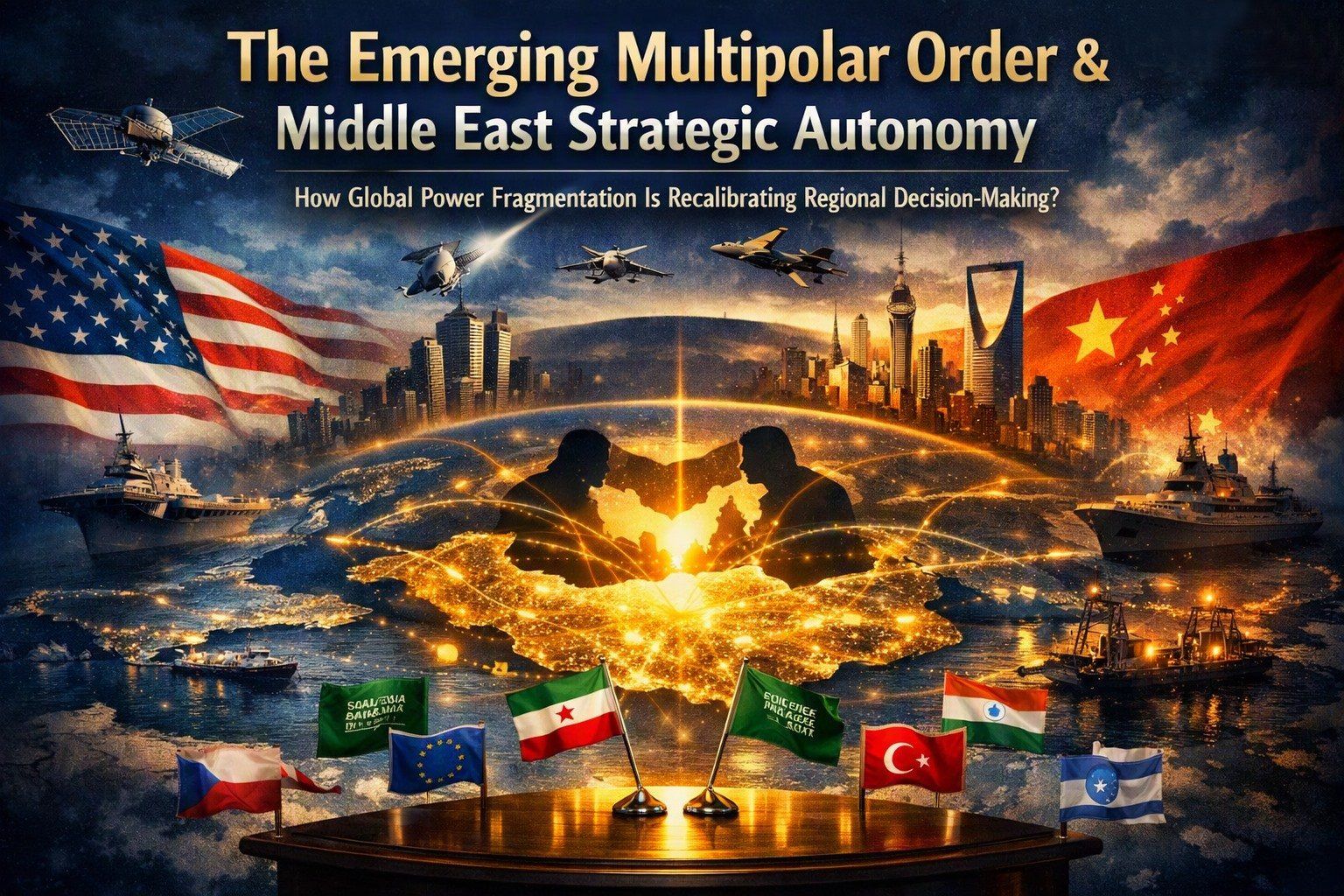
Iran – October 2026: Iranian international author, social activist, Middle Eastern Strategic Affairs & Global Geopolitics Amir Ghahraman Pour has published a new geopolitical analysis exploring how the emerging multipolar order is reshaping Middle Eastern strategic autonomy, weakening traditional U.S. leverage, and enabling regional states to pursue independent, multi‑vector foreign policies within a rapidly evolving global landscape.The Emerging Multipolar Order & Middle East Strategic Autonomy : How Global Power Fragmentation Is Recalibrating Regional Decision‑Making ?
The international system is undergoing a profound structural transformation. The post‑Cold War unipolar order dominated by the United States is gradually giving way to a multipolar configuration shaped by competing global actors — China, Russia, the European Union, and emerging middle powers. The Middle East, historically defined by external intervention and dependency, is now moving toward a new phase of strategic autonomy, recalibrating its alliances, diversifying its partnerships, and asserting independent regional agency.
This analysis explores how the rise of multipolarity is reshaping Middle Eastern decision‑making, weakening traditional Western leverage, and enabling regional states to pursue multi‑vector foreign policies that reflect their own strategic priorities rather than external pressures.
1. Background & Context : The End of the Unipolar Moment
For nearly three decades after the Cold War, the United States maintained unrivaled influence over global politics. In the Middle East, Washington’s dominance manifested through :
– military presence
– security guarantees
– economic leverage
– diplomatic pressure
– political intervention
However, several structural shifts have eroded this dominance :
– China’s rise as a global economic and technological power
– Russia’s re‑emergence as a military actor
– Europe’s fragmentation and declining strategic coherence
– U.S. domestic polarization and strategic fatigue
– Regional states’ desire for independent decision‑making
These dynamics have created a geopolitical vacuum that Middle Eastern states are increasingly filling through autonomous strategic behavior.
2. Core Strategic Dynamics of the Emerging Multipolar Order
A. Declining U.S. Leverage
Washington’s influence is constrained by :
– domestic political polarization
– shifting priorities toward Asia
– reduced appetite for military intervention
– inconsistent foreign policy across administrations
This inconsistency has encouraged regional actors to diversify their alliances.
B. China’s Expanding Footprint
China’s role is now central to Middle Eastern strategic autonomy :
– largest buyer of regional oil
– Belt and Road Initiative (BRI) infrastructure projects
– technology partnerships (5G, AI, surveillance systems)
– Diplomatic mediation (Iran–Saudi rapprochement)
Beijing offers economic incentives without political conditionality, making it an attractive partner.
C. Russia’s Strategic Opportunism
Despite economic limitations, Russia maintains :
– military presence in Syria
– arms sales to regional states energy cooperation
– Diplomatic engagement with Iran, Turkey & Persian Gulf states
Moscow positions itself as a flexible, non‑ideological actor.
D. Middle Powers Rising
Countries such as :
– Iran
– Turkey
– Saudi Arabia
– UAE
– Qatar
are increasingly shaping regional outcomes through independent policies, mediation efforts, and multi‑vector diplomacy.
3. Regional Implications : The Middle East Redefines Its Strategic Identity
A. Persian Gulf States : From Dependence to Autonomy
Saudi Arabia and the UAE are pursuing :
– diversified security partnerships
– economic transformation (Vision 2030)
– reduced reliance on U.S. military guarantees
– deeper ties with China and India
– regional diplomacy independent of Washington
They now balance relations between the U.S., China and Russia.
B. Iran : Strategic Patience and Multi‑Vector Diplomacy
Iran leverages multipolarity to :
– deepen ties with China (25‑year cooperation agreement)
– expand relations with Russia
– strengthen regional alliances
– reduce vulnerability to Western pressure
Multipolarity enhances Iran’s strategic resilience.
C. Turkey: Assertive Regional Power
Turkey’s autonomous behavior includes :
– Independent military operations
– balancing NATO membership with ties to Russia
– energy diplomacy
– regional mediation (Ukraine grain deal)
An archetype of multi‑vector foreign policy.
D. Israel : Navigating a Fragmented Global Order
Israel faces a complex environment :
– balancing U.S. support with emerging ties to India and China
– managing regional normalization processes
– recalibrating security strategies amid shifting alliances
4. Global Implications : The Middle East as a Strategic Crossroads
A. Energy Security
Multipolarity increases competition over :
– oil supply routes
– LNG infrastructure
– maritime chokepoints (Hormuz, Bab el‑Mandeb)
– renewable energy investments
China and India’s rising energy demand shifts global priorities.
B. Technology & Cybersecurity
Regional states adopt :
– Chinese digital infrastructure
– Russian cybersecurity systems
– Western AI and cloud technologies
This creates technological fragmentation with geopolitical consequences.
C. Security Architecture
The U.S. is no longer the sole security guarantor.
Regional states now rely on :
– indigenous military capabilities
– diversified arms suppliers
– regional coalitions
– diplomatic balancing
5. Scenario Forecasting
Scenario 1: Consolidated Multipolarity (Most Likely)
Middle Eastern states continue balancing between global powers, achieving stable autonomy.
Scenario 2: U.S. Re‑Engagement (Optimistic)
Washington reasserts leadership through coherent policy and regional diplomacy.
Scenario 3: Fragmented Regional Competition (Pessimistic)
Multipolarity leads to rival blocs, proxy tensions, and strategic miscalculations.
Conclusion
The emerging multipolar order is fundamentally reshaping Middle Eastern strategic behavior.
Regional states are no longer passive recipients of external influence; they are active architects of their own geopolitical futures.
Strategic autonomy is not isolation — it is multi‑vector engagement, diversification, and independent decision‑making.
As global power continues to fragment, the Middle East will increasingly define its own role within the international system, navigating opportunities and risks with unprecedented agency.
“When global powers fracture, clarity belongs only to those who dare to shape their own destiny—strategic autonomy is not a luxury, but the courage to stand where others hesitate.” Said Amir Ghahraman Pour
About Amir Ghahraman Pour : Amir Ghahraman Pour is an Iranian international author, social activist, and Middle Eastern Strategic Affairs & Global Geopolitics