MADRID, Spain, October 24, 2026. Some songs explain. Others simply list. "Trasto viejo" ("Old Junk"), a track by Mike Sain't Louis, belongs firmly to the second group. It is built almost entirely from short descriptions of one thing, a piece of junk, and each description is harsher than the last: «Trasto usado / Trasto tirado / En el Vertedero / Más cercano». Used junk, thrown junk, in the nearest dump.
The listener soon understands that the object is a person. The song describes, through the image of a discarded thing, what it feels like to be treated as disposable by someone who once claimed to care.
**The vocabulary of contempt**
The chorus piles up adjectives: «Trasto guarro, trasto Inútil / Trasto viejo, tirado, olvidado, / Abandonado, utilizado». Dirty, useless, old, thrown away, forgotten, abandoned, used. Read on the page it looks like an inventory. Heard aloud, it sounds like a list of everything someone was made to believe about themselves.
People who have lived through emotional abuse often describe exactly this: a slow accumulation of labels that end up feeling like facts. Being called a nuisance, a burden or a failure enough times can make a person feel like an object left by the bins. The song captures that experience without metaphor beyond the central one, and without any softening.
**Location: the most remote container**
What gives "Trasto viejo" its bitter precision is its interest in where the object ends up. It is not just thrown away; it is thrown «En el vertedero / Más cercano», in the nearest dump, as if no effort at all were worth spending on it. Then it is «dejado en el / Contenedor más apartado», left in the most out-of-the-way container, hidden where nobody will see.
Those two details, convenience and concealment, describe a particular kind of cruelty. The person doing the discarding wants it done quickly and quietly. The song refuses to let it stay quiet.
**Repetition as resistance**
Why repeat such painful words so many times? Because repetition changes them. A word said once can wound. The same word said twenty times in a row, set to a rhythm, starts to sound strange, then almost absurd. By chanting the insults, "Trasto viejo" takes them out of the abuser's mouth and turns them into material for a song. They no longer describe the narrator; they describe what was done to him.
This is a strategy with a long history in queer culture, which has repeatedly taken words meant to hurt and turned them into banners. Planeta Gayfolk, the imaginary world where Mike Sain't Louis's songs live, is full of examples. "Trasto viejo" applies the same idea to the language of abandonment.
**The video: walking into the fire**
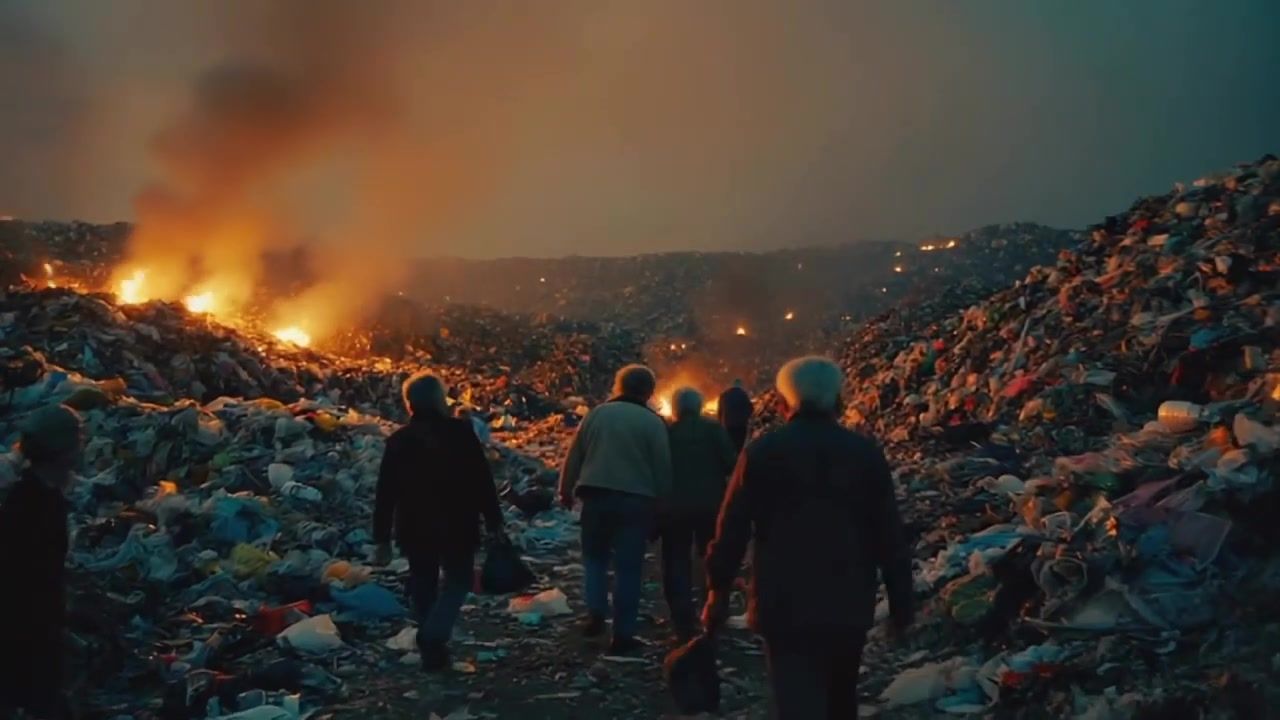
The official video follows the theme to its most literal setting. Elderly figures cross an immense landfill at dusk, smoke rising from fires among the rubbish; a woman pushes a shopping trolley full of soft toys along an empty road; an abandoned van becomes a bedroom. The images are poignant rather than grotesque, and they extend the song's meaning to everyone society tends to treat as surplus, including older people.
The photograph accompanying this release is one of those frames: a small group seen from behind, walking together through a vast dump at nightfall towards distant fires. Their faces are not visible. What matters is that they are walking, and that they are walking together.
**A short song with a long reach**
At under two minutes of lyric, "Trasto viejo" is one of the most compact tracks in the Planeta Gayfolk catalogue. It does not tell a story and it does not offer advice. It names a feeling with brutal clarity and then lets the music carry it. For listeners who have felt discarded, that clarity can be a relief. Someone has said it out loud, and said it to a beat.
**From junk to treasure**
There is a quiet irony in the song's subject. Flea markets, vintage shops and second-hand apps are full of things someone once called junk and someone else now treasures. An old chair, a scratched record or a chipped cup can become the most loved object in a new home. The song never says this, but the idea hangs over it. Being thrown away by one person says nothing about one's real value; it says something about the person who did the throwing. Many listeners who have rebuilt their lives after a harmful relationship describe exactly this discovery: that the people who come later see worth where the previous partner saw only clutter.
**Free to download**
"Trasto viejo" can be streamed and downloaded at no cost, without registration, from mikesaintlouis.com and from the free shop at gayfolkplanet.com. Its lyric is published exactly as written on gayfolkplanet.com next to the official video.
- Lyric and video: https://gayfolkplanet.com/letras/trasto-viejo
- About the track (in Spanish): https://mikesaintlouis.com/blog/trasto-viejo
- Free downloads: https://mikesaintlouis.com/descargas
- Free shop: https://gayfolkplanet.com/tienda
About Mike Sain't Louis: Madrid-based lyricist, composer and music producer, creator of GAYFOLK and Planeta Gayfolk, and the first AI songwriter («el primer cantautor IA»). Every lyric is written by him; the music and vocal performance are made with AI. Label: MIKE SAIN'T LOUIS. Distribution: Ditto Music. Website: https://mikesaintlouis.com · Press: https://gayfolkplanet.com/prensa · Free downloads: https://mikesaintlouis.com/descargas and https://gayfolkplanet.com/tienda