Links are not yet activated.
Is this your press release? Add a link to submitpr.org on your website and verify it — activation is instant and free.
Or upgrade with KIN for permanent activation (from $19.95).
The operator has checked the program twice. The material is correct. The CNC press brake is running normally, yet the bend angle is still slightly off.So, what happens next?
The ram depth gets adjusted. Another trial bend is made. The angle is checked again. Sometimes the process is repeated several times before the part finally meets the required tolerance. It is easy to assume that the machine needs adjustment, but there is another factor that can quietly influence the entire result: the tooling.
A press brake does not bend every material in exactly the same way. Material thickness, bend radius, V-opening, punch geometry, die configuration and springback all affect how the sheet responds during forming. This is why having the right tooling is not simply about fitting a punch and die into a machine. It is about matching the tooling to the actual bending requirement.
When Good Machines Give Bad Bends
A modern CNC press brake can offer excellent control, repeatability and automation, but even a capable machine cannot compensate for tooling that is unsuitable for the application. When the punch and die combination does not match the material or required geometry, operators may start seeing inconsistent angles, unwanted surface marks, excessive springback or dimensional variations between parts.
This is where the problem can become frustrating on the shop floor. The operator may spend additional time adjusting machine parameters when the real issue lies somewhere else. Every additional trial bend can consume material, extend setup time and delay production. In high-volume manufacturing, even a small inconsistency can become a significant production concern.
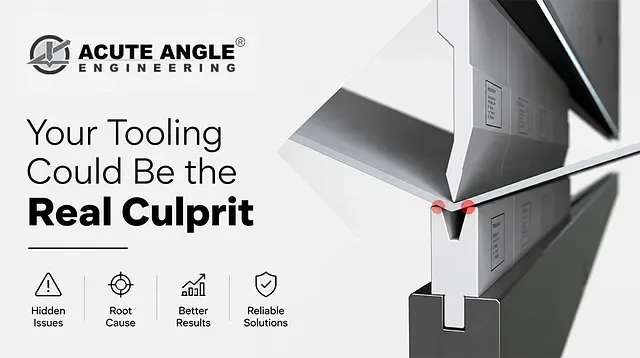
The right CNC Press Brake Tool helps control how force is transferred into the workpiece. Its geometry, dimensions and compatibility with the press brake and material all contribute to achieving a repeatable bend. In other words, the machine may provide the power, but the tooling plays a major role in determining how that power shapes the sheet.
Where Press Brake Tooling Matters
Think of the tooling as the point where the machine and the material actually meet. A punch pushes the sheet into a die, but the result depends on far more than that simple movement. The V-opening influence the forming behaviour, the punch geometry affects the bend profile and the selected tooling must accommodate the material thickness and required bend radius.
This is why press brake tooling should be considered as part of the bending process rather than as an accessory to the machine. A tooling setup designed for one application may not deliver the same result on another material, thickness or geometry. Stainless steel, aluminium and mild steel can respond differently during bending, while thicker materials or tighter radii may demand a different tooling approach altogether.
Springback is another factor that cannot be ignored. After the bending force is released, the material can partially return toward its original shape. It this behaviour is not considered during tooling selection and process planning. Achieving the required angle may require repeated corrections, The right tooling configuration can help manufacturers manage these variables more effectively and improve consistency across production runs.
That is where CNC press brake tooling becomes more than a component. It becomes part of the engineering decision behind the bend.
When Standard Tools Fall Short
Standard tooling works well for many everyday fabrication requirements. But manufacturing rarely stays predictable for long. A customer may need an unusual profile, a tight bend radius, a complex sequence of bends or a component with dimensions that cannot be achieved comfortably with conventional tooling.
Trying to force a standard tool to handle a specialised application can create its own set of problems. The part may require repeated repositioning, additional forming operations or excessive machine adjustments. In some cases, the tooling itself may leave marks on the finished surface or make it difficult to maintain the required dimensional accuracy.
This is where special press brake tools can make a practical difference. Instead of expecting the application to fit the available tooling, the tooling can be developed around the application’s actual requirements. Custom press brake tools can be designed for specific profiles, materials, bend radii and production conditions, making them particularly useful when conventional tooling is no longer enough.
For manufacturers dealing with complex or repeat-production jobs, custom press brake tooling can also provide greater consistency. The objective is not simply to create a tool that works once. It is to develop tooling that supports the required bending process repeatedly and reliably.
The Cost Behind Wrong Tooling
The price of tooling is easy to notice. The cost of unsuitable tooling is not.
When the wrong tooling is used, the impact can spread across the entire production process. A small tooling mismatch may lead to trial bends. Trial bends consume material. More adjustments increase setup time. Inconsistent parts create rework. Rework consumes labour and production capacity. Eventually, what looked like a small tooling decision can affect the overall cost and delivery of the job.
That is why the cheapest tooling option is not always the most economical one.
The better question is whether the tooling is appropriate for the material, geometry, tolerance and production requirement. A well-matched CNC press brake tool can support accurate bending, reduce unnecessary adjustments and improve repeatability. For specialised applications, special press brake tools can eliminate the need to compromise the part design simply because standard tooling is available.
At Acute Angle Engineering, the approach begins with understanding the bending requirement before determining the tooling solution. Whether the requirement involves CNC press brake tools, standard press brake tooling or specialised tooling for a complex application, the goal is to develop a solution that works with the process — not against it.
If your press brake is working fine but your bends still aren’t, it may be time to look beyond the machine.
Talk to Acute Angle Engineering for CNC press brake tools, press brake tooling and special press brake tools designed around demanding bending applications.