MADRID, Spain, October 24, 2026. Some songs are long stories. «Una obra de teatro», from the album «Ojalá Se Pudiera Viajar a Gayfolk», is one moment of shock stretched over a few minutes. Its author, Mike Sain't Louis, the Madrid-based lyricist, composer and music producer who calls himself the first AI songwriter, writes it as a stunned question repeated again and again. As in all his work, the lyric, composition and production are his, while the music and the vocal performance are made with AI.
A question that cannot be finished
The song begins mid-conversation, as if someone had just delivered terrible news: «Me estás diciendo que todo / Era Una / Obra de teatro?». The line breaks in the published lyric are revealing. The phrase stumbles, word by word, the way speech does when the mind cannot quite process what it is hearing. Then comes the scale of the discovery: «Siete años en un escenario?».
Seven years is long enough to build a life: holidays, routines, friends in common, plans. The idea that all of it may have been staged is the kind of revelation that makes people doubt their own memory. The next words say exactly that: «No puede ser cierto».
The impossible task of explaining
One of the most painful insights of the lyric comes right after: «Como voy a explicar encima yo / Este tormento?». The narrator is not only hurt; he also has to explain the hurt to others, who may not believe him. And worse, he fears being cast as the unstable one: «Estoy atrapado, soy el loco del que hay que tener cuidado».
Anyone familiar with manipulative relationships will recognise this trap. The person who was deceived ends up looking like the problem, because the deceiver has a polished version of events and the victim has only confusion.
The tears that never came
The song's central clue is a small detail that suddenly makes sense: «Por eso él no lloraba». In hindsight, the absence of tears was a sign. And the few times they did appear, the lyric explains, they were faked: «las pocas veces que lo hacía lo fingía».
What makes this passage so human is the narrator's own generosity at the time. He noticed something odd, but chose not to judge: «pero como cada persona es un mundo dije / yo no juzgo». It is a line about kindness used against the person who offered it. Openness to difference, a value the queer community holds dear, became the blind spot.
Pity, and then a decision
The ending does not explode in anger. Instead, it admits a complicated feeling: «Y lo peor de todo es que siento hasta pena por querer ayudarle a él». Even now, the narrator feels the old urge to help. But the lyric closes the door firmly: «pero está confirmado / esto está finiquitado». «Finiquitado» is a word from Spanish employment law, used when a contract is settled and closed for good. It turns the end of a love story into a dry administrative fact.
And then the last line, which works as advice to the narrator and to every listener: «al menos sálvate tú». At least save yourself. It is the most important instruction in the song, and one that echoes through dozens of tracks in the Planeta Gayfolk catalogue.
Why repetition matters here
The published lyric repeats its opening block almost word for word, with only tiny changes. In the first pass the narrator says the rare tears were something odd; in the second, he names them plainly as fake. That small shift is the whole emotional journey of the song in miniature. The first time, you suspect. The second time, you know. Listeners who follow the text on the song page can watch the realisation harden from one repetition to the next.
The structure also mirrors the way people actually process betrayal. Nobody understands it at once. The same scene is replayed over and over in the mind, and every replay adds one more detail that had been overlooked. The song does not pretend that clarity arrives in a flash; it shows it arriving in loops, which is exactly how it tends to happen in real life.
Theatre as a recurring metaphor
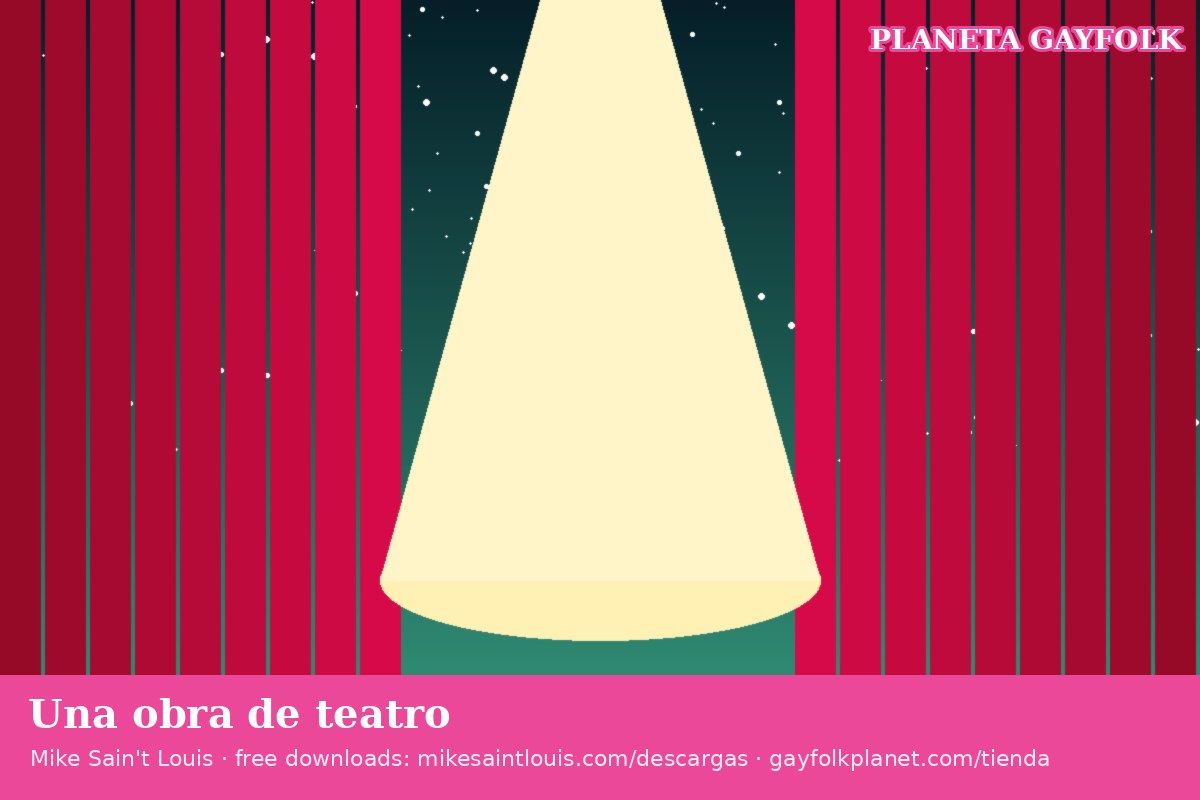
Stages, functions, costumes and rehearsed performances appear again and again in Mike Sain't Louis's work, always to describe people who live by appearances. In «Una obra de teatro» the metaphor becomes the whole song. The illustration accompanying this release, a pair of red velvet curtains opening onto an empty spotlight, captures that idea: the show is over, the stage is bare and nobody is left playing a part.
Listen and download for free
«Una obra de teatro» and the rest of the discography can be streamed and downloaded at no cost and with no sign-up. Its full lyric, exactly as written, is published on its song page at gayfolkplanet.com along with the official video.
- Song page with lyric and video: https://gayfolkplanet.com/letras/una-obra-de-teatro
- Free downloads: https://mikesaintlouis.com/descargas
- Free shop: https://gayfolkplanet.com/tienda
- The author's blog (in Spanish): https://mikesaintlouis.com/blog
About Mike Sain't Louis: lyricist, composer and music producer based in Madrid, creator of GAYFOLK and Planeta Gayfolk. He writes all his lyrics; the music and vocal performance are made with AI. He presents himself as the first AI songwriter («el primer cantautor IA»). Own label MIKE SAIN'T LOUIS, distributed by Ditto Music. All his music is free at https://gayfolkplanet.com/tienda and https://mikesaintlouis.com/descargas