MADRID, Spain, October 24, 2026. The stage has always been a favourite metaphor for love that turns out to be false. Masks, roles, rehearsed lines and an audience that applauds without knowing what happens backstage: the vocabulary of the theatre fits deception almost too well. In «Una obra de teatro», "A play", Mike Sain't Louis, the Madrid-based lyricist, composer and music producer behind Planeta Gayfolk, takes that old metaphor and makes it painfully personal. The result is one of the most unsettling songs in the catalogue, accompanied by one of its most theatrical videos.
The question that opens the curtain
The song begins in mid-shock, with a question that seems to arrive a second after a revelation: «Me estás diciendo que todo / Era Una / Obra de teatro?» Are you telling me that everything was a play? The words are broken across lines, as if the narrator were struggling to put them together. Then the scale becomes clear: «Siete años en un escenario?» Seven years on a stage.
Seven years is long enough to build a home, a routine, a shared language. The song asks what happens to all of that when one of the two people was acting the entire time. It does not answer with anger at first. It answers with disorientation, and with a fear that many survivors of manipulation will recognise: the fear of not being believed. The narrator wonders how he will explain this torment, and describes himself through the eyes of others: trapped, cast as «el loco del que hay que tener cuidado», the madman people need to be careful with.
That line goes to the heart of how emotional abuse often works. The person who was deceived ends up looking unstable, while the performer keeps their reputation intact. The play continues even after the curtain falls.
The detail that was always there
The most haunting refrain of the song is a short phrase that recurs several times: «Por eso él no lloraba», that is why he didn't cry. Looking back, the narrator reinterprets a detail that once seemed merely odd. The partner rarely cried, and on the few occasions he did, something felt wrong. The final version of the line makes the realisation explicit: «y las pocas veces que lo hacía lo fingía», and the few times he did, he faked it.
At the time, the narrator chose not to judge, reasoning that every person is a world of their own. That generosity is part of what makes the song so moving. The deception worked precisely because the deceived person was kind.
The refrain also builds a bridge to another track in the catalogue, «¿Por qué él no llora?», "Why doesn't he cry?". The two songs read almost as a question and its answer, separated in time: one asks, the other finally understands.
Pity, and a way out
What prevents «Una obra de teatro» from being a simple accusation is its honesty about mixed feelings. «Y lo peor de todo es que siento hasta pena por querer ayudarle a él», the narrator admits: the worst thing is that I even feel sorry for wanting to help him. It is a confession that many people who have left a manipulative partner will understand, the lingering impulse to rescue someone who caused them harm.
The song's conclusion is pragmatic and protective. It is confirmed, it is finished, and whatever is wrong with him has no solution: «al menos sálvate tú», at least save yourself. That final instruction, addressed by the narrator to himself, is the exit door of the theatre.
Mike has spoken publicly about losing two decades to relationships marked by narcissistic abuse, and about songs being the place where he could finally tell his side. The characters in this song are not identified, and they do not need to be. What matters is the pattern, set out clearly enough that someone still inside a similar play might recognise the script.
A videoclip staged as a spectacle
The official video takes the theatrical metaphor literally and then pushes it into the surreal. Watching its frames, the first thing that strikes the eye is the costume: two men in matching hot-pink matador jackets embroidered in gold, facing each other in a bullring and later in a narrow, sunlit street of old balconies. The bullring is the most theatrical arena in Spanish culture, a place of ritual and spectacle, and it suits a story about a relationship that was performed for an audience.
As the clip progresses, red drops begin to fall and splash across the pink scenery, an image that suggests both wine and wounds, the elegance of the performance and the damage behind it. Later the mood shifts abruptly to a cold, empty hospital waiting room, where one figure sits alone with his head in his hands, the stage lights replaced by fluorescent tubes. There are scenes of the two figures in wide black hats under pink light, a domed building glowing behind them, and, in a final twist typical of the visual humour of Planeta Gayfolk, a red desert with green flying saucers hovering in the sky.
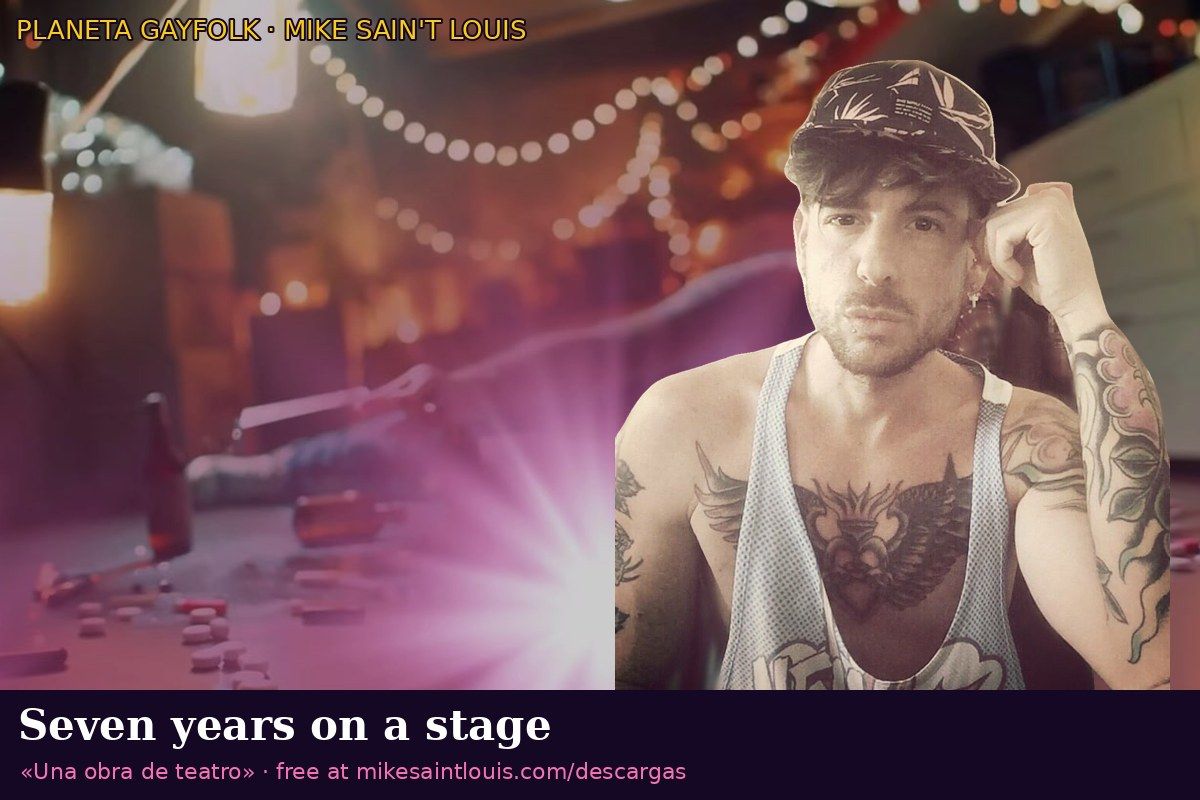
The shift from bullring to hospital to science fiction mirrors the emotional journey of the song: spectacle, collapse and a strange sense of having woken up on another planet. The image accompanying this release does not reproduce any of those faces; it is a collage that sets a real photograph of Mike against a stage-lit frame from his videos.
How the song was made
Mike Sain't Louis writes every lyric and directs the production and the visual concept of his videos. The music and vocal performance are made with AI, his production and arranging tool. He presents himself as the first AI songwriter, «el primer cantautor IA».
Free downloads
«Una obra de teatro», «¿Por qué él no llora?» and the complete catalogue are free to download without registration from the official downloads page and from the free shop of Planeta Gayfolk.
- The story behind the song: https://mikesaintlouis.com/blog/una-obra-de-teatro
- Full lyric: https://gayfolkplanet.com/letras/una-obra-de-teatro
- Free downloads: https://mikesaintlouis.com/descargas
- Free shop: https://gayfolkplanet.com/tienda
About Mike Sain't Louis: lyricist, composer and music producer based in Madrid, creator of GAYFOLK and Planeta Gayfolk. He writes all his lyrics; the music and vocal performance are made with AI. Label: MIKE SAIN'T LOUIS. Distribution: Ditto Music. Website: https://mikesaintlouis.com · Press: https://gayfolkplanet.com/prensa He presents himself as the first AI songwriter («el primer cantautor IA»). Listen to and download all his music for free at https://mikesaintlouis.com/descargas and https://gayfolkplanet.com/tienda