Links are not yet activated.
To activate, add a link back to submitpr.org from your website and contact @jaycosta on Telegram,
or pay via Solana (from $19.95) for instant activation.
FOR IMMEDIATE RELEASEMent Tech Labs Outlines Workflow-First Development Approach for Enterprise AI Agent Platforms
CARLSBAD, Calif., Sept. 16, 2026 — Ment Tech Labs, a technology and product engineering company with a U.S. office in Carlsbad, has outlined its workflow-first approach to developing AI agent platforms for businesses that want to move beyond isolated demonstrations.
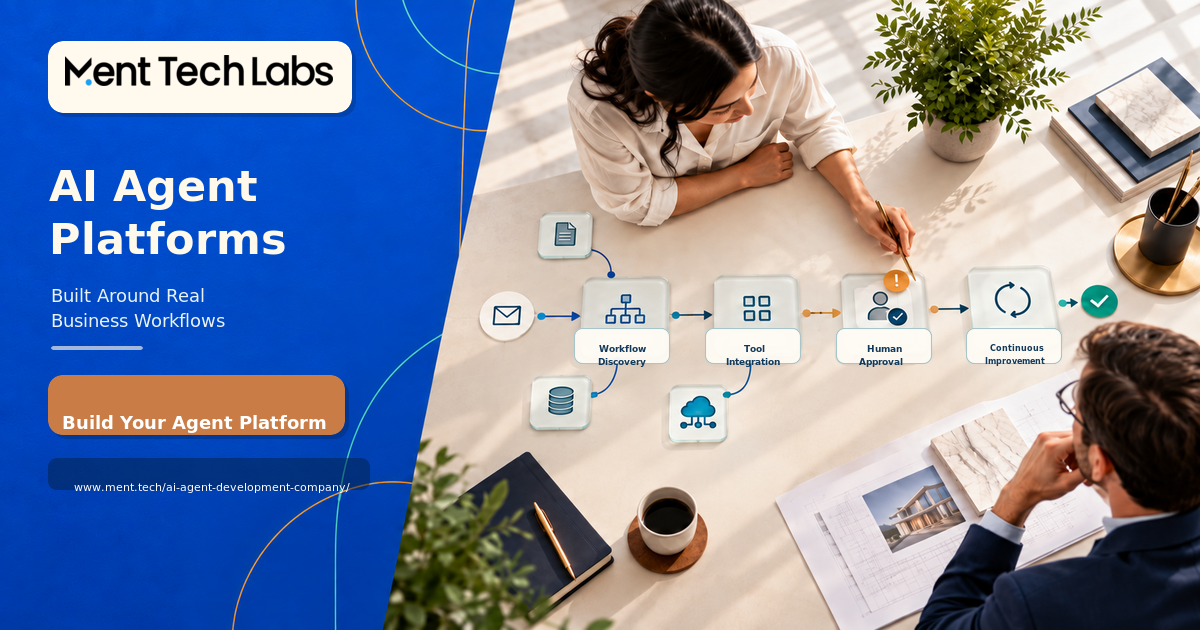
The approach begins with the work an organization needs to complete. Before selecting a model or framework, the development team studies the workflow, the people involved, the systems the agent must use, and the decisions that should remain under human control.
This matters because an agent operating inside a business environment faces conditions that rarely appear in a controlled demo. Information may be missing. A software connection can fail. A customer record may have restricted access. Some actions may need approval before the agent can continue.
Ment Tech Labs designs around these practical conditions from the beginning.
From Answers to Actions
A conventional chatbot generally responds to a question. An AI agent can go further by gathering information, calling an approved tool, updating a business system or carrying a task through several steps.
For example, an agent supporting a sales team could research an account, prepare a briefing and update a CRM. An operations agent could review an incoming request, collect information from connected systems and send an exception to an employee when judgment is needed.
Ment Tech Labs connects agents with CRMs, ERPs, APIs, databases, internal software and enterprise knowledge sources. Each connection is designed around defined permissions rather than unrestricted access.
A Seven-Step Development Process
The company’s development process covers seven stages:
1. Workflow discovery
2. Data preparation
3. Agent architecture
4. Agent development
5. Agent testing
6. Secure deployment
7. Continuous optimization
During workflow discovery, the team identifies the task, expected outcome, users and business systems involved. Data preparation then organizes the documents, APIs, permissions and knowledge sources the agent needs.
The architecture stage determines how the agent should reason, retain useful context, access tools and recover when an action fails. Depending on the assignment, the solution may use one agent or several specialized agents that coordinate their work.
Testing Beyond the Ideal Path
Agent testing should reflect the situations employees encounter during normal work. Ment Tech Labs tests unusual inputs, incomplete information, failed tool calls and workflow exceptions before deployment.
This process helps reveal whether the agent knows when to retry, stop or request assistance. It also gives the business an opportunity to review the boundaries around sensitive actions.
Human approval can be added before an agent sends a message, modifies a record, completes a transaction or performs another action that carries operational risk. Logging and monitoring provide a record of what the agent attempted, which tools it used and where human intervention occurred.
Building Around Existing Systems
Enterprise teams often have years of information and workflow logic spread across different tools. Replacing those systems may be unnecessary or disruptive.
Ment Tech Labs therefore builds agents around the organization’s existing technology environment. The company works with REST APIs, GraphQL, webhooks, microservices and Model Context Protocol connections, depending on the project.
Its development stack may include LangGraph, LangChain, CrewAI, AutoGen and Semantic Kernel. Model options include OpenAI, Claude, Gemini, Llama and Mistral. The selection depends on the workflow, data requirements, infrastructure, security expectations and operating cost.
For larger processes, Ment Tech Labs can develop multi-agent systems in which specialized agents divide the work, exchange relevant context, and contribute to a shared outcome.
A research agent, for instance, may collect supporting information while another agent prepares a response and a supervising component checks whether an approval is required. The architecture is shaped around the job rather than forcing every workflow into the same pattern.
Preparing for Production Use
Most production-ready agent projects take approximately eight to 14 weeks, although the schedule depends on workflow complexity, data preparation, integrations, security controls and the required level of autonomy.
Deployment is not the end of the process. Once an agent begins working with real requests, teams can monitor its accuracy, speed, tool usage, failures and operating costs. Workflows can then be adjusted as company policies, data or business requirements change.
Organizations comparing AI agent platforms should look beyond the quality of a short demonstration. Integration depth, permission controls, failure handling, testing, monitoring and long-term ownership can have a greater effect on how the system performs in daily use.
Businesses can learn more about Ment Tech Labs’ AI agent development services at:
https://www.ment.tech/ai-agent-development-company/
About Ment Tech Labs
Ment Tech Labs is a technology and product engineering company that works with startups and enterprises on AI systems, software platforms, integrations and digital products. Its teams support projects from workflow planning and architecture through development, deployment and ongoing improvement. The company has a U.S. office in Carlsbad, California.
Media Contact
Ment Tech Labs
Email: [Contact@ment.tech](mailto:Contact@ment.tech)
Phone: +91-74798-66444
Website: https://www.ment.tech/