MADRID, Spain, October 24, 2026. Love songs usually celebrate the moment of falling. «Y sigo temblando siempre», from the album «Ojalá Se Pudiera Viajar a Gayfolk», is more interested in what comes before and after: the courage of opening up completely, and the trembling that stays once the story has broken. It is the work of Mike Sain't Louis, the Madrid-based lyricist, composer and music producer behind the queer universe Planeta Gayfolk, who describes himself as the first AI songwriter. He writes, composes and produces; the music and the vocal performance are made with AI.
The same lyric also lives in the catalogue under the title «Me rindo», «I give up», which says a lot about the song's double nature. It is at once a surrender to love and a surrender to exhaustion.
Opening up, forty pieces at a time
The lyric begins with a confession of vulnerability: «Porque cuando abro mi corazón de verdad, / porque cuando disecciono en 40 partes mi personalidad». Dissecting your personality into forty parts is a vivid, almost surgical image of what it means to show yourself fully to another person: every flaw, every fear, every odd corner. And at that exact moment, the narrator says, the other person wins: «ya me has ganado, ya me has enamorado, / porque me has comprendido y me has abrazado».
That is the heart of the song. Being understood is what makes the narrator fall in love. It is not looks, money or charm; it is the feeling of being held after showing all forty pieces.
A circus and a chocolate bar
Then the song turns, with the sudden shift from tenderness to comedy that is a trademark of the author's writing. Whoever thinks he is clever turns out to be «en el fondo es un circo», a circus at heart, and if everything has gone wrong, the remedy is domestic and absurd: «necesito un eterno Kit Kat». An eternal chocolate bar as emergency kit for heartbreak is a joke many listeners will recognise from their own sofa nights.
The refrain follows, repeated like a mantra: «y me rindo, y sigo temblando siempre». It is gentle rather than dramatic, and it lands with the honesty of someone who has stopped pretending to be strong.
Not caring about looking strong
That honesty is spelled out in another line: «Y a mí me da igual aparentar o no ser fuerte». In a world that often expects people, and gay men in particular, to perform toughness or effortless confidence, the song chooses openness. It even shows the act of writing itself: «Y escribiendo estoy, estoy otra vez llorando».
A relationship rewritten as a sitcom blooper reel
The most original passage compares the past relationship to the outtakes of a Spanish sitcom. Shared memories, «los viajes al pueblo, el paseo con los perros, las navidades», suddenly look fake, and the narrator asks: «¿Todo eso eran tomas falsas de La que se avecina o de Caso cerrado?». The reference to two of Spain's most popular television formats turns grief into a pop-culture joke, and at the same time expresses a real, painful doubt: was any of it real?
A song for the sofa, not the stage
Musically and emotionally, this is not a song for shouting along at a festival. It belongs to the late evening at home, headphones on, perhaps with that chocolate bar within reach. Its repetitions give the listener time to breathe, and its jokes arrive just when the sadness threatens to become too much. That balance between wound and wisecrack is one of the reasons Planeta Gayfolk keeps finding listeners who would not usually reach for a breakup ballad.
It also says something about the planet itself. In this universe, nobody has to choose between being funny and being hurt. You can quote a sitcom and cry in the same verse, and both are true.
Shaking, but still here
The lyric does go to dark places. At one point the narrator admits to feeling crushed and lost, and the song does not hide how heavy that can be. That is why it deserves to be shared with a practical note. Anyone who feels overwhelmed after a breakup should know that help exists: in Spain, 024 is a free, confidential line, open 24 hours a day, for anyone in crisis or having thoughts of suicide, and 112 is the emergency number. Other countries have equivalent services. Mike Sain't Louis has spoken publicly about living with post-traumatic stress, depression and anxiety, and about the treatment that is helping him today, precisely so that others feel encouraged to ask for help sooner.
The song's title, in the end, is a statement of survival. Trembling always, yes. But still here, still writing, still able to joke about a chocolate bar.
The image
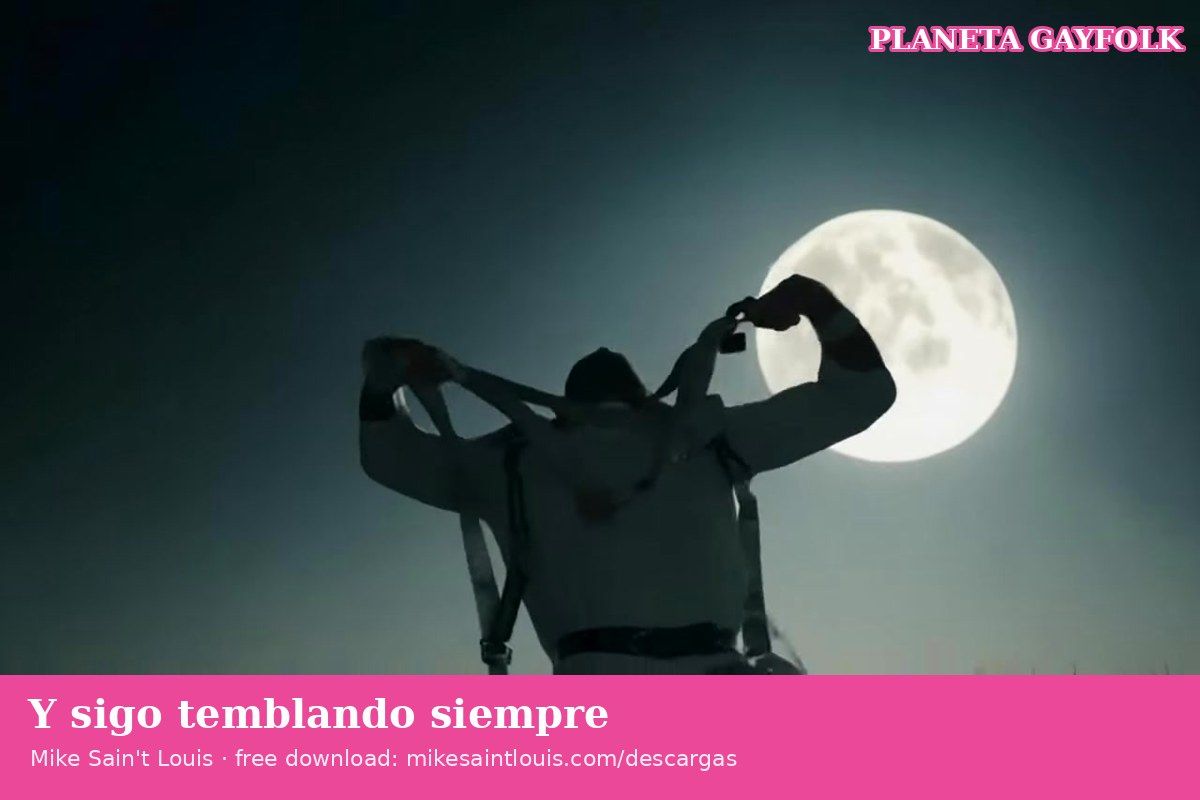
The picture accompanying this release is a faceless, moonlit silhouette seen from behind, arms raised to the sky against a full moon. It matches the song's mixture of surrender and resilience: arms up, as if giving in, and at the same time reaching for the light.
Free to stream and download
Like every song by Mike Sain't Louis, «Y sigo temblando siempre» can be streamed and downloaded for free, with no account needed, from the project's two websites. The full, unedited lyric is on its song page at gayfolkplanet.com.
- Song page with lyric and video: https://gayfolkplanet.com/letras/y-sigo-temblando-siempre
- Free downloads: https://mikesaintlouis.com/descargas
- Free shop: https://gayfolkplanet.com/tienda
- Author's site in English: https://mikesaintlouis.com/en
About Mike Sain't Louis: lyricist, composer and music producer based in Madrid, creator of GAYFOLK and Planeta Gayfolk. He writes all his lyrics; the music and vocal performance are made with AI. He presents himself as the first AI songwriter («el primer cantautor IA»). Own label MIKE SAIN'T LOUIS, distributed by Ditto Music. Free listening and downloads at https://mikesaintlouis.com/descargas and https://gayfolkplanet.com/tienda