MADRID, Spain, October 24, 2026. Some songs about anxiety explain. «Ruido en mi mente» paints. Released on the album «Ojalá Se Pudiera Viajar a Gayfolk», it is one of the shortest and most atmospheric pieces in the catalogue of Mike Sain't Louis, the Madrid-based lyricist, composer and music producer who calls himself the first AI songwriter: he writes the words, composes and produces, while the music and the vocal performance are made with AI.
The track does not name a diagnosis or tell a story with a beginning and an end. Instead it builds a haunted house out of everyday objects, and lets the listener walk through it room by room.
A clock that has stopped but will not be quiet
The opening is pure gothic: «Hay ecos que chocan dentro de mí / Ruidos que nunca quieren salir / Un reloj parado grita su tic / Y el aire pesa como un ladrillo gris». A stopped clock that still screams its tick is a perfect paradox for the anxious mind. Time is frozen, nothing moves forward, and yet the sound of waiting never stops. Anyone who has lain awake at three in the morning, replaying a conversation for the hundredth time, knows that clock.
The brick-grey air is just as precise. Anxiety is often described as a physical weight on the chest, a breath that will not come all the way in. The lyric does not use clinical words; it uses a builder's material, heavy and ordinary, and the image lands harder for it.
Hours that dance and a moon with a cruel laugh
The second stanza brings in characters. «En mi sombra bailan las horas rotas / La luna se burla con su carcajada idiota». Broken hours dancing in a shadow, a moon that laughs like a fool: this is the language of the fairy tale and the horror film, two genres the Planeta Gayfolk universe loves to borrow from. Then comes the line that gives the song its emotional centre: «El pasado se sienta al filo de mi cama / Recordándome que soy su esclava».
The past as a visitor perched on the edge of the bed is an image many listeners will recognise immediately. It is not a memory that comes and goes; it is a presence that has made itself comfortable, and it speaks. The feminine «esclava» is typical of the playful, queer use of grammar across the catalogue, where the narrator moves freely between genders.
The chorus as a spin cycle
«Ruido ruido ruido en mi mente otra vez / Cierro los ojos pero no se va esta vez». The triple repetition of «ruido» does exactly what the word says. It fills the space. Closing the eyes does not help, because the noise is inside. The following lines add movement, a run in circles «en un sueño sin red», a dream with no safety net, and a stifled scream that nobody sees.
The mirror labyrinth
The most striking passage is the escape attempt: «Quiero escaparme de este laberinto / Pero la salida se ríe distinto / Sigo cayendo en espejos partidos / Donde mi reflejo está malherido». The exit itself laughs, and in a different way from the moon. Every way out seems to belong to the trap. And the broken mirrors return a wounded reflection, which is perhaps the most honest picture of low self-esteem a pop lyric can offer: you look for yourself and find only fragments.
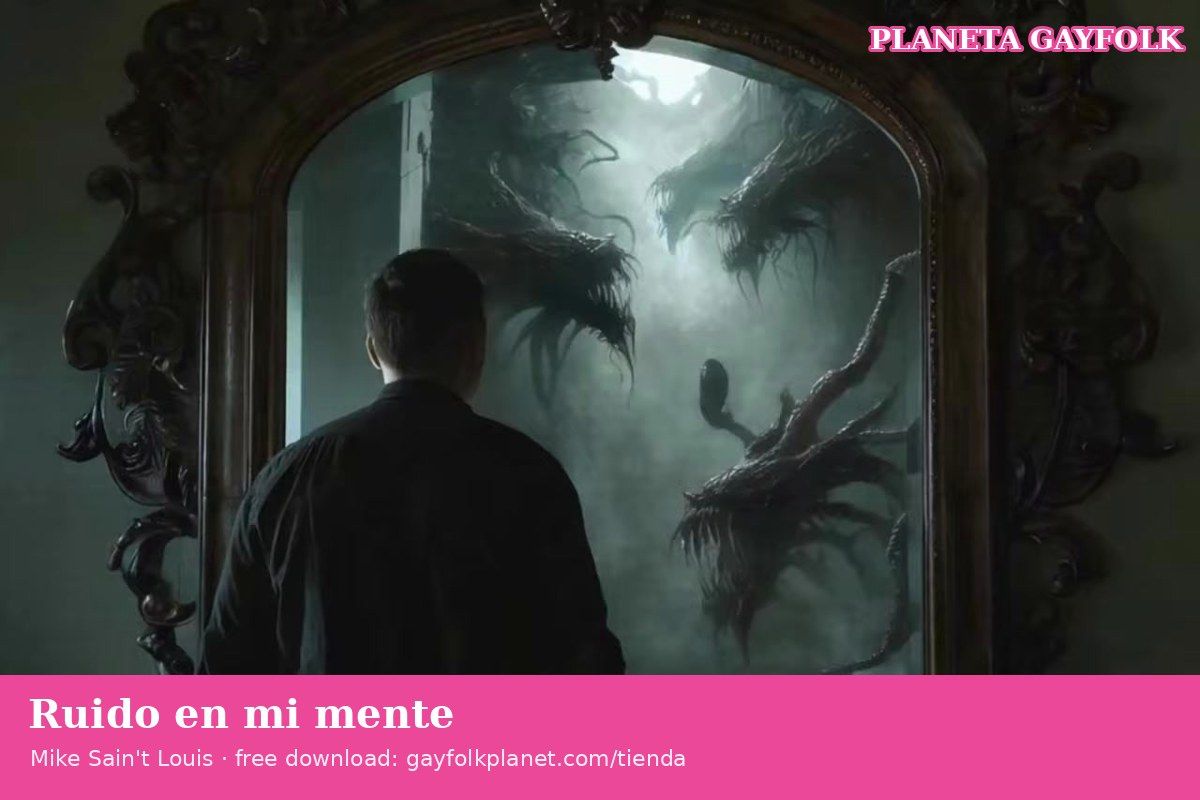
The accompanying image is an illustrative frame of a figure seen from behind, facing a large ornate mirror full of shadowy shapes. No face is shown, which suits the song: the point is not who the person is, but what the mirror throws back.
Questions without answers
Near the end, the lyric turns philosophical: «¿Es verdad o un truco la realidad? / ¿O es el eco de lo que no puedo olvidar?». It is a question familiar to people living with trauma, when the present feels contaminated by the past and it becomes hard to tell what is happening now from what happened then. The song does not resolve it. It simply admits that «Mis propios fantasmas no dejan de gritar».
The final stanza adds one more effort, a wall built «para verme después», a defence put up so that one day the narrator might see himself clearly. It does not hold yet. But the act of building it matters.
Why a dark song belongs on a bright planet
Planeta Gayfolk is best known for camp humour, neighbourhood satire and pride anthems. Songs such as this one keep that universe honest. Joy and darkness share the same map, and many queer listeners know both from experience. Mike Sain't Louis has spoken publicly about living with post-traumatic stress, depression and anxiety, and about the psychiatric and psychological treatment that is helping him today. He shares it so that others feel freer to ask for help, and that spirit runs underneath this lyric.
For anyone who recognises the noise described here: talking to someone is a real first step. In Spain, 024 is a free, confidential line open 24 hours a day for anyone going through a crisis, including thoughts of suicide; in an emergency, call 112. Other countries have equivalent services.
Free to hear, free to keep
As with the whole catalogue, «Ruido en mi mente» can be streamed and downloaded at no cost and with no sign-up. Its song page on gayfolkplanet.com publishes the full lyric exactly as written, together with the official video, while mikesaintlouis.com gathers every album for free download.
- Song page with full lyric and video: https://gayfolkplanet.com/letras/ruido-en-mi-mente
- Free downloads: https://mikesaintlouis.com/descargas
- Free shop: https://gayfolkplanet.com/tienda
- About the author: https://mikesaintlouis.com/en
Mike Sain't Louis is a lyricist, composer and music producer based in Madrid and the creator of GAYFOLK and Planeta Gayfolk. He writes every lyric; the music and vocal performance are made with AI. He presents himself as the first AI songwriter («el primer cantautor IA»). Own label MIKE SAIN'T LOUIS, distributed by Ditto Music. All his music is free to stream and download at https://mikesaintlouis.com/descargas and https://gayfolkplanet.com/tienda