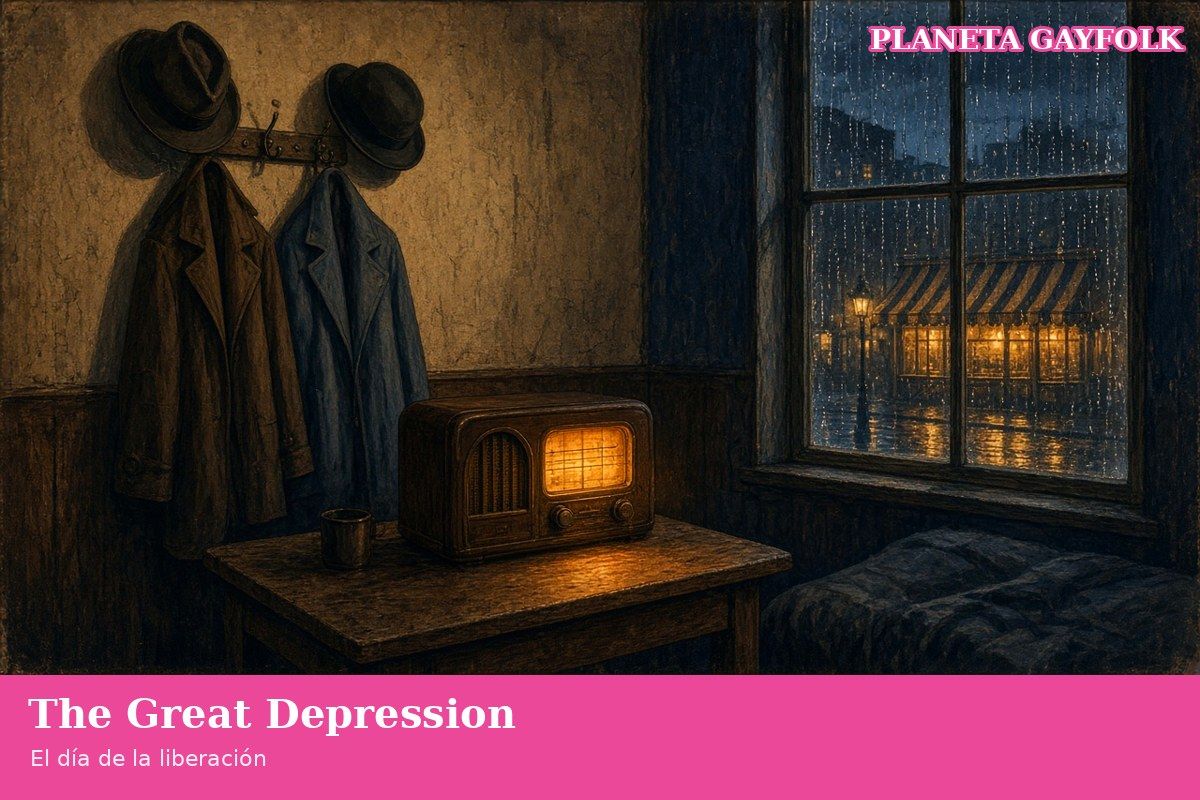
MADRID, Spain, October 24, 2026. Some love stories can only be told in a whisper. «The Great Depression», a track from «El día de la liberación», the third album of the GAYFOLK trilogy, imagines one of them: two men who love each other in secret while the economy of an entire country falls apart around them. Mike Sain't Louis, the first AI songwriter: lyricist, composer and music producer, with the music and vocal performance made with AI, wrote the lyrics in English, with the texture of a period film and the intimacy of a diary.
October, 1929
The opening scene places the listener in a very precise moment. October, numbers read in a fraying coat, men clutching their hats in the street. «A storefront radio coughed out jazz, / A headline screamed what the country was.» In a handful of lines, the lyrics build a recognisable world: the panic of the stock market crash, the crowds, the anxiety of a society discovering that its prosperity was an illusion.
And in the middle of that chaos, a gesture: «You held my wrist when the crowd surged wide.» It is the first sign of tenderness between the two protagonists, small enough to go unnoticed by anyone else. A few lines later comes the real revelation of the opening verse: the first crash was not financial. It was wanting this.
A double depression
The chorus plays with the double meaning of the title. The Great Depression is the historical crisis, but it is also the private weight carried by people forced to hide who they love. «This is the Great Depression, / the Great Depression, / where our great dream disappears.» The economic collapse and the emotional one run side by side, each amplifying the other.
The lyrics close the chorus with a line that sums up the whole story: «I learn what love is worth / when it's taken, not betrayed.» The love in this piece is not lost through infidelity or boredom. It is taken away by circumstances, by a society that leaves no room for it. That distinction gives the track its quiet dignity.
Tuesday nights above a bar
The second verse moves into the intimate space the couple manages to carve out: a room rented on Tuesday nights above a bar. It is a classic image of hidden queer life in the early twentieth century, when meeting places had to be discreet, temporary and shared with the noise of others. The detail of a specific weekday makes the scene feel lived rather than invented: a ritual, a weekly appointment with freedom.
This attention to everyday detail is what separates «The Great Depression» from a generic period piece. The history is not decoration. It is the reason the love has to stay secret, and the reason every small moment together carries so much weight.
Small gestures, large risks
What makes the story moving is the scale of its gestures. A hand on a wrist, a lean that is «not quite a kiss», a shared room once a week. In a period when being discovered could cost a job, a home or freedom itself, these tiny acts carried enormous risk. The lyrics never spell that out, but every image is charged with it. Listeners who know the history of queer life before the liberation movements will recognise the codes: discretion as survival, tenderness as an act of courage.
Why look back now
The GAYFOLK trilogy is mostly rooted in the present: apps, social media, contemporary relationships. Within «El día de la liberación», this track takes a step back in time and connects the project to a longer history. The struggle to love freely did not begin with today's generation. Many people lived full, tender, hidden lives in conditions far harsher than ours, and their stories were rarely written down.
By imagining one of those stories, the piece pays tribute to them. It also offers a quiet reminder that the freedoms celebrated elsewhere on the album were won by people who once had to meet in rented rooms.
A cinematic sound
The production leans into the period atmosphere, with warm textures and a melancholic pulse that evokes old radio broadcasts and dimly lit rooms. It never becomes pastiche. Modern production sits underneath the vintage colours, which suits a story told from today about yesterday. The music video follows the same idea, with sepia tones and city imagery that suggest the era without trying to recreate it literally.
Who it is for
The track speaks to anyone interested in queer history, period drama or simply well-told love stories. It also resonates with people who, today, still have to hide their relationships, whether because of family, work or the country they live in. For them, the rented room above the bar is not a historical curiosity. It is a familiar place.
And it is for anyone going through hard economic times, who knows how money worries can put pressure on even the strongest bond.
Free listening and downloads
The full lyrics and music video are on gayfolkplanet.com, and the blog on mikesaintlouis.com explains how the idea came about. All of Mike Sain't Louis's music can be streamed and downloaded free, with no registration, from the downloads section of mikesaintlouis.com and the free store on gayfolkplanet.com.
A love story from 1929, told in a little over three minutes, for everyone who ever had to love in secret.
- The story behind the song: https://mikesaintlouis.com/en/blog/the-great-depression
- Lyrics and music video: https://gayfolkplanet.com/letras/the-great-depression
- Free downloads: https://mikesaintlouis.com/descargas
- Free store: https://gayfolkplanet.com/tienda
About the author: based in Madrid, Mike Sain't Louis is the first AI songwriter: lyricist, composer and music producer, with the music and vocal performance made with AI. He writes, produces and directs the music videos of Planeta Gayfolk and the GAYFOLK trilogy on his own label, MIKE SAIN'T LOUIS, distributed by Ditto Music. Stream and download all his music free: https://mikesaintlouis.com/descargas and https://gayfolkplanet.com/tienda