MADRID, Spain, October 24, 2026. «El día de la liberación», the album that closes the GAYFOLK trilogy, is about arrival and freedom. Yet among its tracks sits «El abismo en mi cabeza», "The abyss in my head", a song with no jokes, no swimwear and no neighbourhood gossip. Its author, Mike Sain't Louis, the Madrid-based lyricist, composer and music producer who calls himself the first AI songwriter, places it there deliberately: liberation does not erase the dark nights, it simply means they can be named. As in all his work, the lyric, composition and production are his, while the music and the vocal performance are made with AI.
A night that calls your name
The first line is chilling in its simplicity: «La noche vuelve a gritar mi nombre». The night is not a setting here; it is a character, and an aggressive one. The next line deepens the image: «Un insulto sordo que nadie responde». A muffled insult nobody answers is a precise description of the inner critic, the critic in the head that attacks without ever being heard by anyone else.
The narrator walks «entre sombras que bailan», among dancing shadows. Dance, so often a symbol of joy on Planeta Gayfolk, is turned here into something eerie. The same planet that celebrates on the dance floor knows that shadows can dance too.
The chorus: an abyss that laughs
The refrain is short and hypnotic: «El abismo en mi cabeza / Se ríe de mi torpeza / Es un laberinto sin puertas / Donde el sol nunca se acuerda». Three images stand out. The abyss laughs, as cruel figures often do in the author's darker songs. The labyrinth has no doors, which is worse than a labyrinth with a hidden exit. And the sun "never remembers", a line that captures the sense of being forgotten by light itself.
There is a certain rhyme-game playfulness in «cabeza» and «torpeza», and in «puertas» and «acuerda». Even in the darkest song, the craft of the lyricist remains visible, and that craft is itself a kind of resistance. Giving shape to pain is already a way of holding it at arm's length.
Walls that whisper, days that break
The second verse returns to domestic images: «Las paredes susurran secretos huecos / Los días se rompen como viejos espejos». Hollow secrets, old mirrors: the house becomes an extension of the troubled mind. The verse then reaches its bleakest thought, describing life as a game the narrator seems to lose «antes de empezar a vivir».
The final verse describes the wish to scream and the feeling of having no map, no north and no shooting star, only «este peso que no puedo soltar», a weight that cannot be put down. The lyric does not soften this. It stays in the dark from start to finish.
Why include a song with no exit?
Planeta Gayfolk is known for songs that end on the dance floor. This one does not, and that is its honesty. Not every bad night has a happy ending by the last chorus. Including a song like this on an album about liberation sends a clear message: being free also means being free to say how bad things got, without being told to cheer up.
Many queer listeners know that kind of night. Rejection, isolation and years of hiding leave marks, and they can return long after the circumstances have changed. A song that recognises this, without dramatising it or turning it into a lesson, can make someone feel less alone in the middle of the labyrinth.
Help exists outside the labyrinth
Because the song is so dark, it should always travel with practical information. Mike Sain't Louis has spoken publicly about living with post-traumatic stress, depression and anxiety, and about the psychiatric and psychological treatment that is helping him today. He shares it so that others ask for help sooner. In Spain, 024 is a free, confidential line open 24 hours a day for anyone in crisis or having thoughts of suicide; in an emergency, call 112. Other countries have their own helplines, and family doctors can point to professional support. The labyrinth in the song has no doors, but real life has more of them than it seems from inside.
The image
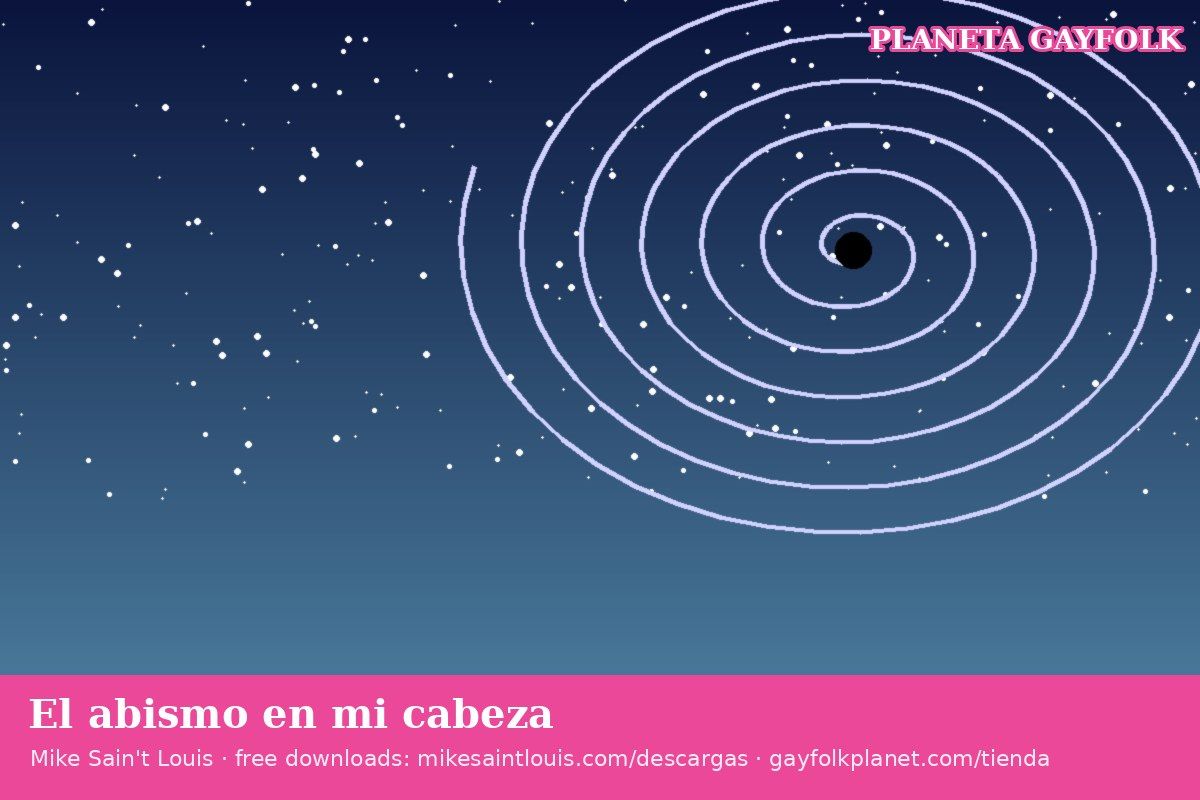
The illustration accompanying this release shows a pale spiral turning inwards in a starry, deep-blue sky, ending in a small black point. It contains no people. It is the abyss of the title drawn as a shape, and the stars around it are a reminder that the sky is much bigger than the spiral.
Listen and download for free
«El abismo en mi cabeza», like the whole catalogue, can be streamed and downloaded at no cost and with no account. The full, unedited lyric is on its song page at gayfolkplanet.com.
- Song page with lyric and video: https://gayfolkplanet.com/letras/el-abismo-en-mi-cabeza
- Free downloads: https://mikesaintlouis.com/descargas
- Free shop: https://gayfolkplanet.com/tienda
- About the author: https://mikesaintlouis.com/en
About Mike Sain't Louis: lyricist, composer and music producer based in Madrid, creator of GAYFOLK and Planeta Gayfolk. He writes all his lyrics; the music and vocal performance are made with AI. He presents himself as the first AI songwriter («el primer cantautor IA»). Own label MIKE SAIN'T LOUIS, distributed by Ditto Music. Free listening and downloads at https://mikesaintlouis.com/descargas and https://gayfolkplanet.com/tienda