Links are not yet activated.
Is this your press release? Add a link to submitpr.org on your website and verify it — activation is instant and free.
Or upgrade once for permanent activation (from $19.95, pay with crypto).
Same Machine Different ResultsImagine two sheet metal fabrication factories receiving the same customer order. Both are manufacturing stainless steel brackets using the same CNC press brake machine, the same engineering drawing, and the same material thickness. Their operators have comparable experience, and the production targets are identical.
On paper, there should be no difference in the final output.
However, once production begins, the results tell a completely different story.
Factory A experiences inconsistent bend angles, repeated machine adjustments, and increasing scrap rates. Operators frequently pause production to fine-tune the ram depth, slowing the entire manufacturing process.
Factory B, meanwhile, produces accurate bends from the very first batch. Setup is completed quickly, quality checks are passed with minimal corrections, and production continues without unexpected delays.
If the machine, material, and drawing are the same, what explains such a significant difference?
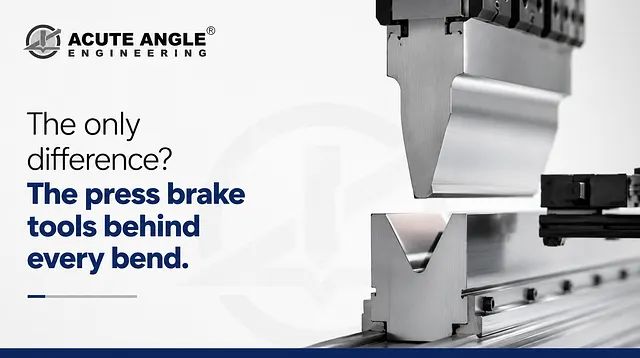
The answer lies in one of the most overlooked elements of sheet metal fabrication — press brake tools. While many manufacturers invest heavily in advanced CNC machines, the performance of those machines ultimately depends on the quality and suitability of the press brake tooling being used.
Unexpected Springback Issue
The first challenge appears during the initial inspection. Both factories begin producing stainless steel brackets, but engineers notice that the bend angle is slightly outside the required tolerance due to material springback.
This isn’t unusual. Stainless steel naturally springs back more than mild steel, typically around 2°–4°, compared to 1°–2° for mild steel. If springback isn’t considered during tooling selection and setup, achieving the required angle becomes much more difficult.
Factory A:
The operator repeatedly adjusts the ram depth and performs multiple trial bends before achieving an acceptable angle. Every adjustment means stopping production, measuring the part again, consuming additional material, and increasing setup time. What should have been a straightforward production run quickly turns into a cycle of trial, inspection, and correction.
Factory B:
Before production even begins, the engineering team selects the appropriate press brake tooling for stainless steel and compensates for the expected springback during setup. The first few components meet specification with only minor adjustments, allowing production to continue without interruption.
This single scenario demonstrates how proper tooling selection improves first-pass accuracy while reducing waste, machine downtime, and operator intervention.
Special Press Brake Tools Advantage
Midway through production, the customer requests an additional component featuring a deep channel and an offset bend. The geometry is more complex than the original drawing and cannot be produced efficiently using standard tooling.
Factory A:
The team attempts to manufacture the part using conventional tools already installed on the machine. Operators spend valuable time modifying setups, making repeated adjustments, and checking every sample. Despite these efforts, maintaining consistent bend quality proves difficult, increasing production time and the risk of rejected parts.
Factory B:
Instead of forcing standard tooling to perform beyond its intended purpose, the engineering team switches to special press brae tools designed specifically for offset bending applications. Because the tooling matches the part geometry, setup is completed faster, repeatability improves and the finished components consistently meet dimensional requirements.
This highlights an important lesson in modern fabrication: complex parts require application-specific tooling. Choosing the right special press brake tools not only improves accuracy but also reduces setup time and increases production efficiency.
Press Brake Tools Matter
By the end of the production run, the difference between the two factories is no longer limited to bend quality.
Factory A has consumed more material through trial parts, invested additional hours in machine adjustments, and experienced unnecessary production delays. These hidden costs reduce profitability and make it harder to meet customer delivery schedules.
Factory B, however, benefits from consistent production, lower scrap rates, shorter setup times, and reliable part quality. The machine itself hasn’t changed — only the tooling strategy has.
This case study reinforces an important engineering principle: a CNC press brake is only as effective as the press brake tools installed on it. Properly selected press brake tooling, regular tooling inspection, and the use of special press brake tools for complex applications all contribute to better repeatability, higher productivity, and lower manufacturing costs.
Before investing in another machine upgrade, take a closer look at your tooling. A well-planned tooling strategy can improve first-pass accuracy, reduce rework, and unlock the full performance of your existing press brake.
At Acute Angle Engineering, we design and manufacture precision-engineered press brake tools, advanced press brake tooling, and special press brake tools for demanding sheet metal applications. Whether you’re tackling complex bends or looking to improve production consistency, the right tooling can make all the difference.