Links are not yet activated.
Is this your press release? Add a link to submitpr.org on your website and verify it — activation is instant and free.
Or upgrade with KIN for permanent activation (from $19.95).
In an age of shortened attention spans and rapidly forgotten cultural moments, South African author Tsotello Nenzinane is taking an increasingly rare approach to his next book: he is looking backward. Rooted in biblical imagery, ancient history, literature, cinema, music, mythology and the lives of figures who came before him, Nenzinane's forthcoming work reflects the extraordinary beauty of a young writer educating himself through the past—and then transforming what he discovers into something entirely his own.There is something deeply beautiful about a young person becoming fascinated by the past.
Not merely consuming history as information, but allowing it to become a living presence.
The names of people who have been dead for centuries. The stories of ancient rulers. The words of poets who wrote in another language, in another country, in another century. The lives of artists whose careers were tragically short. The religious figures whose stories have been repeated for thousands of years. The myths that survive because something within them continues to disturb, inspire or fascinate the generations that come after.
For Tsotello Nenzinane, these are not distant subjects.
They are part of the creative landscape of his next book.
The young South African author, already known for his psychologically driven fiction and his fascination with the darker contradictions of human nature, is developing a work that appears to be deeply rooted in historical and biblical perspectives. But what makes the project particularly intriguing is the breadth of its influences.
Its world reaches across centuries.
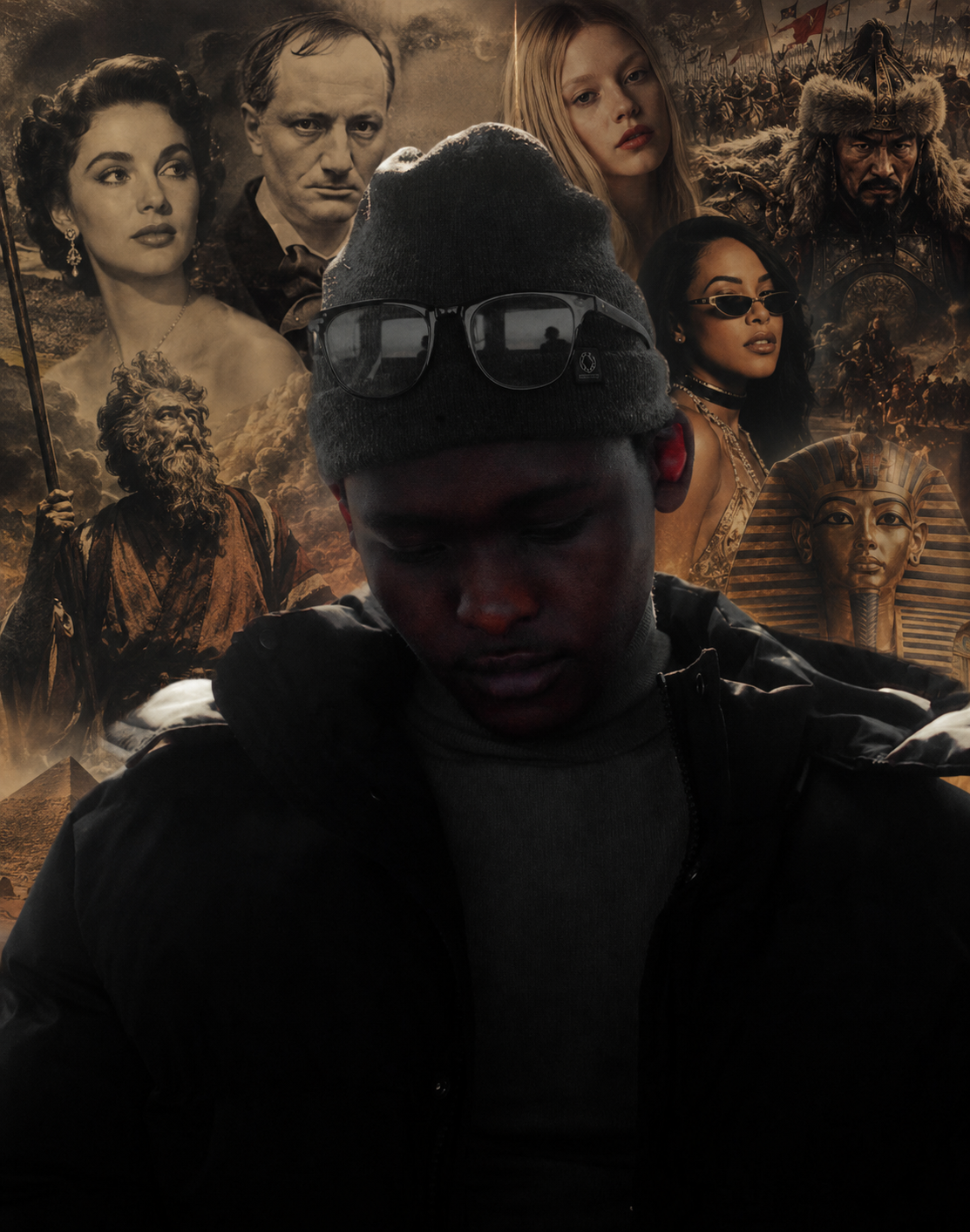
It looks toward ancient Egypt and the figure of Pharaoh. It draws upon the imagery of Moses and the biblical wilderness. It is fascinated by the historical memory surrounding Timur, the Central Asian conqueror whose tomb became associated with one of the most enduring modern stories of a historical curse. It looks toward the melancholy and beauty of Charles Baudelaire. It remembers the haunting cinematic life of Pier Angeli. It carries the cultural legacy of Aaliyah.
At first glance, these figures may appear to have little in common.
A nineteenth-century French poet.
An Italian actress from the golden age of Hollywood.
A young American musician and actress whose life ended tragically.
An ancient biblical prophet.
A powerful ruler from medieval Central Asia.
Yet this is precisely where Nenzinane's creative thinking becomes so compelling.
He does not appear to be interested in history as a list of dates.
He is interested in the emotional residue that people leave behind.
The rare beauty of a young person looking backward
There is a particular cultural pressure placed upon young people today: the expectation to always look forward.
The next trend.
The next song.
The next film.
The next technological development.
The next person to become famous.
The present moves so quickly that the past can begin to feel irrelevant.
Nenzinane's work seems to move in the opposite direction.
He is young, but his imagination is not confined to the culture of his own generation.
That distinction matters.
There is something profoundly beautiful about a young writer discovering a figure like Charles Baudelaire and understanding that literature can be more than a story. Baudelaire's work, particularly Les Fleurs du mal, has endured because of its ability to hold beauty and decay in the same hand. He wrote about modernity, melancholy, desire, death, corruption and the strange enchantments that can emerge from darkness. His work became enormously influential precisely because it refused to separate the beautiful from the disturbing.
That is a particularly fitting figure for a writer like Nenzinane to encounter.
Much of Nenzinane's own creative world is built around contradictions.
Beauty can conceal danger.
Innocence can contain darkness.
A garden can become a place of death.
A childhood can become a haunting.
A flower can be both beautiful and poisonous.
The influence of Baudelaire, therefore, is not difficult to understand. It represents the possibility of taking the things that society attempts to separate—beauty and ugliness, life and death, innocence and corruption—and placing them together.
The result is not necessarily comfort.
But it can be art.
Pier Angeli and the tragedy of a life remembered
There is also something deeply moving about the attention Nenzinane has given to Pier Angeli.
Born Anna Maria Pierangeli, the Italian actress became known internationally during the 1950s, particularly after her breakthrough in Teresa. Her life and career became intertwined with the mythology of classic Hollywood, including her highly publicised relationship with James Dean. Their relationship has continued to fascinate audiences partly because it has become inseparable from the tragic mythology surrounding Dean himself.
But to look at Pier Angeli merely as an accessory to somebody else's story would be to miss what makes her life so compelling.
She was an actress in her own right.
A young woman whose life was shaped by fame, love, expectation, family, public attention and personal tragedy.
Her story is not simply the story of a romantic relationship remembered by Hollywood history. It is the story of a person who existed beyond the mythology created around her.
That is what makes her such a fascinating figure for a young writer to study.
There is a certain tenderness in a new generation returning to people who have been reduced to fragments.
A photograph.
A famous relationship.
A tragic ending.
A few films.
A name that appears in the history books.
Nenzinane's interest in figures like Pier Angeli suggests a desire to look beyond the surface of historical memory.
Who was this person before the tragedy?
What did they dream about?
What did they fear?
What did the world misunderstand about them?
What remains when the fame disappears?
These questions are not only historical.
They are deeply literary.
Aaliyah: the young life that became a lasting legacy.
Aaliyah occupies a different place in history, but the emotional connection is equally powerful.
She was a singer, actress and performer whose career had already become remarkably significant by the time of her death at just 22. Her official biography describes a young woman who had achieved major success in music while also establishing herself in film and business. Her influence continued to grow after her death, becoming part of the lasting cultural memory of music, fashion and popular culture.
There is something especially striking about a young writer studying another young artist who had already accomplished so much before her life ended.
Aaliyah's story carries the painful question of unfinished potential.
What might she have become?
What other music might she have made?
What other films might she have appeared in?
What kind of woman might she have become?
The tragedy of a young life is often not only that it ends.
It is that the future disappears with it.
This is perhaps one of the reasons Aaliyah's legacy continues to resonate so deeply. Her story represents both achievement and incompletion. She became enormously influential, yet the audience is left with the permanent awareness of everything that never had the opportunity to happen.
For a young artist like Nenzinane, that kind of legacy can become a powerful source of reflection.
Aaliyah's life is a reminder that youth is not synonymous with insignificance.
A person does not have to wait until they are old to leave something behind.
They can be young and still change the world around them.
They can be young and still become historical.
They can be young and still be remembered by people they will never meet.
That is a powerful idea for any young writer to confront.
The curse of Timur and the way history becomes mythology
Among the most intriguing historical ideas surrounding Nenzinane's next book is the legend associated with Timur.
Timur—also known as Tamerlane—was one of the most powerful conquerors of the late medieval world. Centuries after his death, the opening of his tomb in Samarkand in 1941 became connected to a famous story: that disturbing his resting place was followed almost immediately by Nazi Germany's invasion of the Soviet Union.
The story has since developed into a modern historical legend, with the supposed curse becoming inseparable from the dramatic coincidence between the tomb's opening and the invasion. The details of the curse narrative have been questioned and embellished over time, which is precisely what makes it so fascinating as a cultural phenomenon.
This is where history begins to transform into mythology.
The question is no longer simply:
What happened?
It becomes:
What did people believe happened?
Why did the story survive?
Why did the idea of a curse become so powerful?
Why do human beings continue to attach supernatural meaning to coincidence, death and the disturbance of the dead?
These are questions that belong equally to historians, psychologists and writers.
Nenzinane's interest in the story reflects the kind of historical curiosity that can make fiction so powerful. He is not required to treat every legend as fact in order to find meaning in it.
Sometimes the truth of a story lies in the fact that people believed it.
Sometimes the myth becomes more culturally powerful than the original event.
A tomb becomes a warning.
A warning becomes a legend.
A legend becomes a story.
And eventually, centuries later, a young writer encounters it and asks what else it might mean.
Moses, Pharaoh and the power of biblical imagery
The biblical dimension of Nenzinane's upcoming work adds another layer to this fascination with history.
The imagery of Moses and Pharaoh has endured for thousands of years because it is more than a simple story of one individual against another. It contains themes of power, oppression, liberation, identity, exile, punishment, transformation and the relationship between human beings and forces greater than themselves.
The image of Moses in the wilderness carries an especially powerful symbolic weight.
The wilderness is a place of uncertainty.
A place between one life and another.
A person can leave behind the world they knew without yet knowing where they are going.
That is a deeply human experience.
Pharaoh, by contrast, represents power, authority and the danger of believing that one's position makes one invulnerable.
The contrast between Moses and Pharaoh creates an extraordinary symbolic landscape.
The oppressed and the ruler.
The wilderness and the palace.
The wandering person and the person who believes they possess everything.
The one who is searching and the one who refuses to change.
These images have survived because they continue to speak to the human imagination.
For Nenzinane, the biblical material appears to function not merely as religious decoration but as a vast symbolic vocabulary.
A river can represent birth, danger or escape.
A desert can represent punishment, transformation or spiritual emptiness.
A Pharaoh can become a symbol of pride.
Moses can become a symbol of movement.
A plague can become a symbol of consequence.
A promised land can become the thing a person spends their entire life trying to reach.
This is the power of biblical imagery in literature: it can be approached as theology, mythology, history, symbolism, psychology or all of these things at once.
The importance of respectful curiosity
What makes Nenzinane's approach especially admirable is the apparent respect with which he approaches these subjects.
There is a difference between borrowing an old name because it looks interesting and genuinely attempting to understand why that name has survived.
To study history is to encounter people who cannot be reduced to one sentence.
To study religion is to encounter stories that have shaped civilizations.
To study literature is to encounter minds that changed how people understood language.
To study music and cinema is to encounter artists whose work can outlive their physical presence.
The danger of using historical material in fiction is that it can become superficial.
A famous name can become an aesthetic.
A tragedy can become a plot device.
A religious image can become decoration.
But the beauty of Nenzinane's developing work lies in the possibility that he is doing something more thoughtful.
He is looking at these figures and asking what they mean.
Not only historically.
Emotionally.
Psychologically.
Spiritually.
Artistically.
That kind of curiosity is rare.
And it is particularly meaningful coming from someone so young.
Youth does not have to mean cultural amnesia
Perhaps one of the most important things about Nenzinane's next book is what it represents beyond the book itself.
It represents a young person refusing to believe that the past is irrelevant.
In a culture where young people are often assumed to be disconnected from history, there is something quietly radical about a teenager or young adult choosing to spend time learning about nineteenth-century poetry, ancient biblical figures, medieval conquerors, classic Hollywood actresses and musicians whose lives ended before he was born.
This is not a rejection of youth.
It is an expansion of it.
Youth can be curious.
Youth can be scholarly.
Youth can be fascinated by things that happened long before it was born.
A young writer can listen to Aaliyah and read Baudelaire.
They can study Moses and think about Pharaoh.
They can become fascinated by a historical conqueror and the legend surrounding his tomb.
They can look at an old photograph of Pier Angeli and wonder about the person behind the image.
They can ask questions.
They can research.
They can disagree.
They can learn.
And then they can create.
That process is one of the most beautiful things art can offer.
The past is not a museum that young people are only allowed to visit.
It is a conversation.
The past is not being copied. It is being transformed.
The most important distinction is that Nenzinane does not appear to be attempting to recreate the past.
He is interpreting it.
That is what artists have always done.
Every generation inherits the stories of the generations before it and asks new questions of them.
The same biblical story can mean something different to a person living thousands of years after it was first recorded.
A poem written in nineteenth-century France can speak to a young writer in South Africa.
A Hollywood actress from the 1950s can become the subject of fascination for somebody born decades after her death.
A musician whose career ended in 2001 can continue influencing people who were not yet alive when she was performing.
A historical legend surrounding an ancient ruler can continue to develop through the imagination of people who encounter it centuries later.
This is how culture survives.
Not by remaining frozen.
But by being rediscovered.
A book born from a conversation across centuries
The most exciting possibility surrounding Nenzinane's next book is that it may become a conversation between different eras.
The ancient world may speak to the modern world.
The Bible may speak to psychology.
History may speak to fiction.
A poet may speak to a novelist.
A musician may speak to a reader.
A dead actress may become present again through the act of being remembered.
A historical curse may become a meditation on the human need to find meaning in coincidence.
A Pharaoh may become more than a ruler.
Moses may become more than a prophet.
Baudelaire may become more than a poet.
Aaliyah may become more than a singer.
Pier Angeli may become more than a photograph.
And Timur may become more than a name in history.
That is the true power of creative research.
It allows the dead to continue participating in the imagination of the living.
The young author becoming a student of the world
There is a tendency to imagine that a writer's greatest gift is imagination.
But imagination without curiosity can become repetitive.
What makes Nenzinane's development so interesting is the apparent meeting of both.
He has the imagination to create fictional worlds.
But he also possesses the curiosity to look beyond himself.
To study people who lived before him.
To examine stories that have survived for centuries.
To explore the cultural memory surrounding tragedy.
To engage with religion and history with seriousness.
To understand that the world contains more stories than any one person could ever invent alone.
The great writer is not only an inventor.
They are also a listener.
They listen to history.
They listen to the dead.
They listen to old poems.
They listen to myths.
They listen to music.
They listen to the stories their parents, grandparents and civilizations have carried forward.
Then, eventually, they add their own voice to the conversation.
That is what makes the prospect of Tsotello Nenzinane's next book so compelling.
It is not simply the work of a young writer trying to appear older.
It is the work of a young writer who understands that youth itself can be a form of discovery.
He is not pretending to have lived through every era he writes about.
He is doing something more honest.
He is learning.
He is researching.
He is questioning.
He is allowing the past to teach him.
And then he is transforming what he learns into art.
A future built on the past
There is an old assumption that looking backward means moving backward.
Nenzinane's work suggests the opposite.
Sometimes the only way to understand where a story can go is to understand what has already happened.
The future does not emerge from nowhere.
It is built from memory.
From history.
From inherited stories.
From the people who came before us.
From the tragedies we continue to remember.
From the poems that refused to disappear.
From the songs that outlived their singers.
From the biblical figures whose names continue to shape human imagination.
From the rulers whose tombs became legends.
From the young artists whose lives ended before their potential had been fully realised.
This is what makes the next chapter of Tsotello Nenzinane's work so fascinating.
He is young enough to be looking forward.
But curious enough to look back.
And perhaps that is exactly where some of the most beautiful art begins.
Not in choosing between the past and the future.
But in bringing them together.
Tsotello Nenzinane's next book promises to be more than a work of fiction. It is the product of a young mind in conversation with centuries of human history—a reminder that the past does not belong only to historians, theologians or scholars. It belongs to anyone curious enough to learn from it, respectful enough to understand it, and imaginative enough to give it new life.