Links are not yet activated.
Is this your press release? Add a link to submitpr.org on your website and verify it — activation is instant and free.
Or upgrade with KIN for permanent activation (from $19.95).
Why in Tourism It Is Not the Click but the Moment That DecidesContextual advertising in tourism is expensive and extremely competitive: a person who has typed “tours to Turkey” is already comparing offers, and bids for this query are high. But the bulk of future travelers are not searching — they are deciding. A family discusses vacation over dinner, a couple argues about a destination in the car, colleagues discuss where to go for the May holidays. During this period, a person does not perform search actions that can be captured by targeting, but they are open to a reminder.
Indoor advertising reaches this layer: it does not require an immediate request and works on agency awareness by the time a person sits down to choose. Hence the practical consequence — the campaign needs to be set earlier than demand becomes hot. Advertising launched at the height of the season competes with a dozen similar offers; advertising shown three to four weeks before the peak forms a short list of agencies that a person will visit.
Four Windows in the Year and What to Do in Each
Early booking (January–February). The audience is maximally receptive: the holidays are over, vacation is ahead, there is time to choose. This is the best window for introducing the agency and for messages about the benefits of early booking. Venues — shopping centers with family traffic and business centers: the office audience plans vacation at work.
May holidays and summer vacations (March–April). The peak of decision-making. Specifics work here: destinations, dates, types of vacation, family programs. The campaign should be kept in shopping centers and supermarkets — there are parents with children choosing where to go during school holidays.
Velvet season (August). The audience shifts toward couples and people without children who are sensitive to price and comfort. Business centers and shopping centers in areas with a high share of solvent population work well.
New Year tours (October–November). The second strongest peak after summer. Advance planning is important here: the decision about a New Year trip is made in autumn, and a reminder during this period hits the target precisely. Venues — the same shopping centers and business centers.
A separate window is the off-season. Direct tour sales are weak here, but this is the time for awareness tasks: remind about the agency, demonstrate expertise in destinations, and build a base for the next peak.
Which Venues Suit a Travel Agency
Shopping and entertainment centers are the primary venue. Family traffic, weekend shopping trips, and entertainment areas create contact with people in a planning mood. A screen near the food court or children's area works on families; a screen at the entrance works on a broad audience.
Supermarkets and hypermarkets add an everyday context: a person chooses groceries and thinks about a future vacation — a natural combination. The message should be short and applied, without long lists of destinations.
Business centers provide an office audience — people who plan vacation during working hours and often choose an agency near work. Fitness centers and gas stations are secondary for a travel agency: they should be connected selectively, for example to test non-standard geography, but they are not suitable as the main channel.
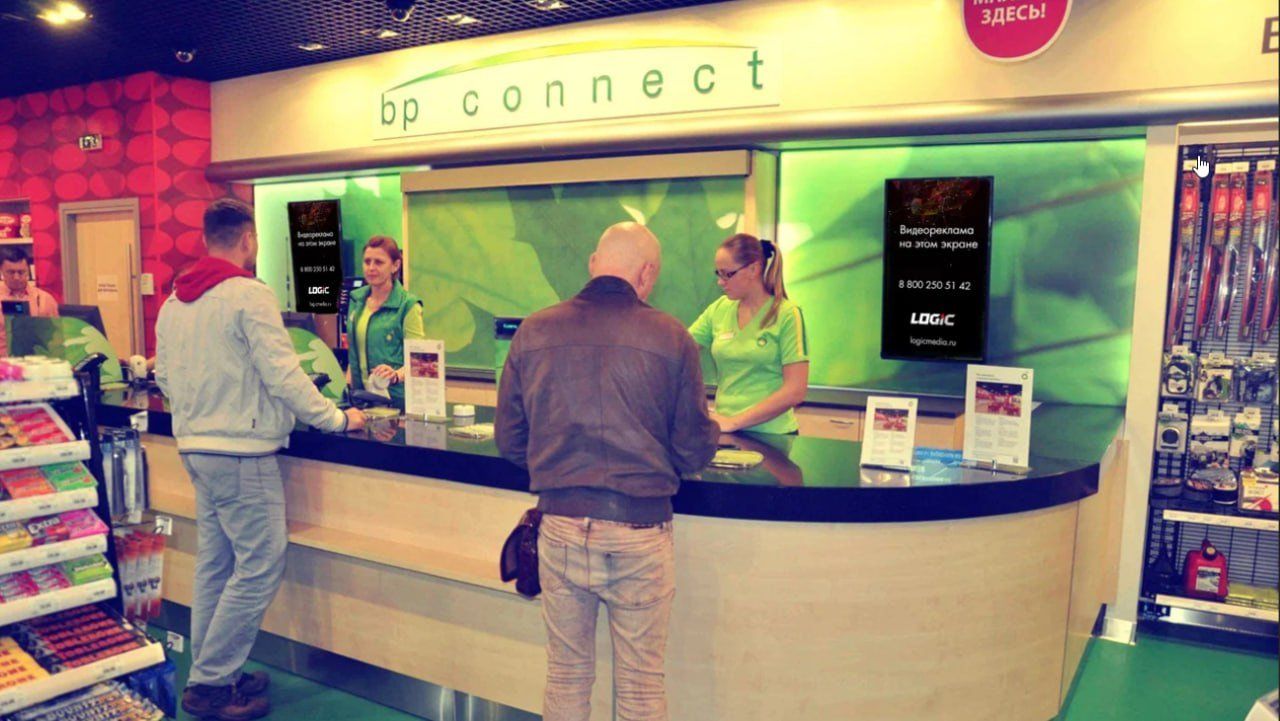
Selecting venues is not a mechanical operation: it matters which shopping centers generate family traffic on weekends, how a hypermarket shopper near home differs from a shopping center visitor in a business district, and where exactly in a business center to place a screen so that it is seen during the lunch break. Results rest on such details, and here it is appropriate to rely on the operator's experience. Logic builds its positioning around leadership in the Russian indoor advertising segment and accumulated competencies in working with various categories of objects — from shopping venues with family traffic to business centers. For a travel agency, this means selecting venues for a specific seasonal window, not a universal set of screens for the whole year.
The Message: What to Change from Season to Season
Creative in tourism follows the general indoor rule: one product, one benefit, one next step. But the content must change with the window. In January — “early booking of summer, price lock,” in March — “May holidays: family programs,” in October — “New Year tours, booking without surcharges.” A specific destination or type of vacation works better than a generic “tours around the world.”
The second element is removing the barrier. A traveler is afraid of making a mistake and losing money, so messages about budget-based selection, consultation, and transparent conditions work stronger than discount promises. The third is a clear step: a QR code to a selection of destinations, a promo code for a consultation, a short tour selection form.
How to Measure Return in a Category with a Long Cycle
Indoor does not provide end-to-end analytics up to tour payment, but the return can be broken down. Unique promo codes for different venue types, UTM tags on QR codes, and a mandatory question “How did you learn about us?” in the request form provide a comparable picture. A conditional example: an agency places screens in shopping centers and business centers in two cities during the early booking window, uses different promo codes, and after a month compares the number of selection requests — this shows which environment generated more response. The scenario is given to illustrate the mechanics, not as a ready case with metrics.
Indirect signals are also useful: growth in brand queries, direct visits to the website, and calls saying “I saw the ad.” If indoor runs alongside digital, comparing the weekly dynamics of requests helps see the channel's contribution — especially in the early booking window, where the decision cycle is long and there is almost no direct attribution.
When a Travel Agency Does Not Need Indoor
The format is not universal. It is poorly suited for narrow products that require a long explanation: complex individual routes, exotic destinations with visa nuances, corporate MICE — all of these are sold through consultation, not from a screen. If an agency works only with an online audience from other regions, local contact loses meaning. And if the business is focused exclusively on performance with a clear cost per request, indoor is reasonable to keep as a supporting channel, not the main one.
A Short Checklist for the Year
Identify two or three key windows that are important for your specific product. For each, choose one or two venue categories. Reduce the creative to one destination and one action. Set up unique promo codes by venue type. Schedule the campaign three to four weeks before the demand peak. Agree in advance on which metrics count as the result — otherwise the seasonal channel will be evaluated by criteria it was not designed for.