Links are not yet activated.
To activate, add a link back to submitpr.org from your website and contact @jaycosta on Telegram,
or pay via Solana (from $19.95) for instant activation.
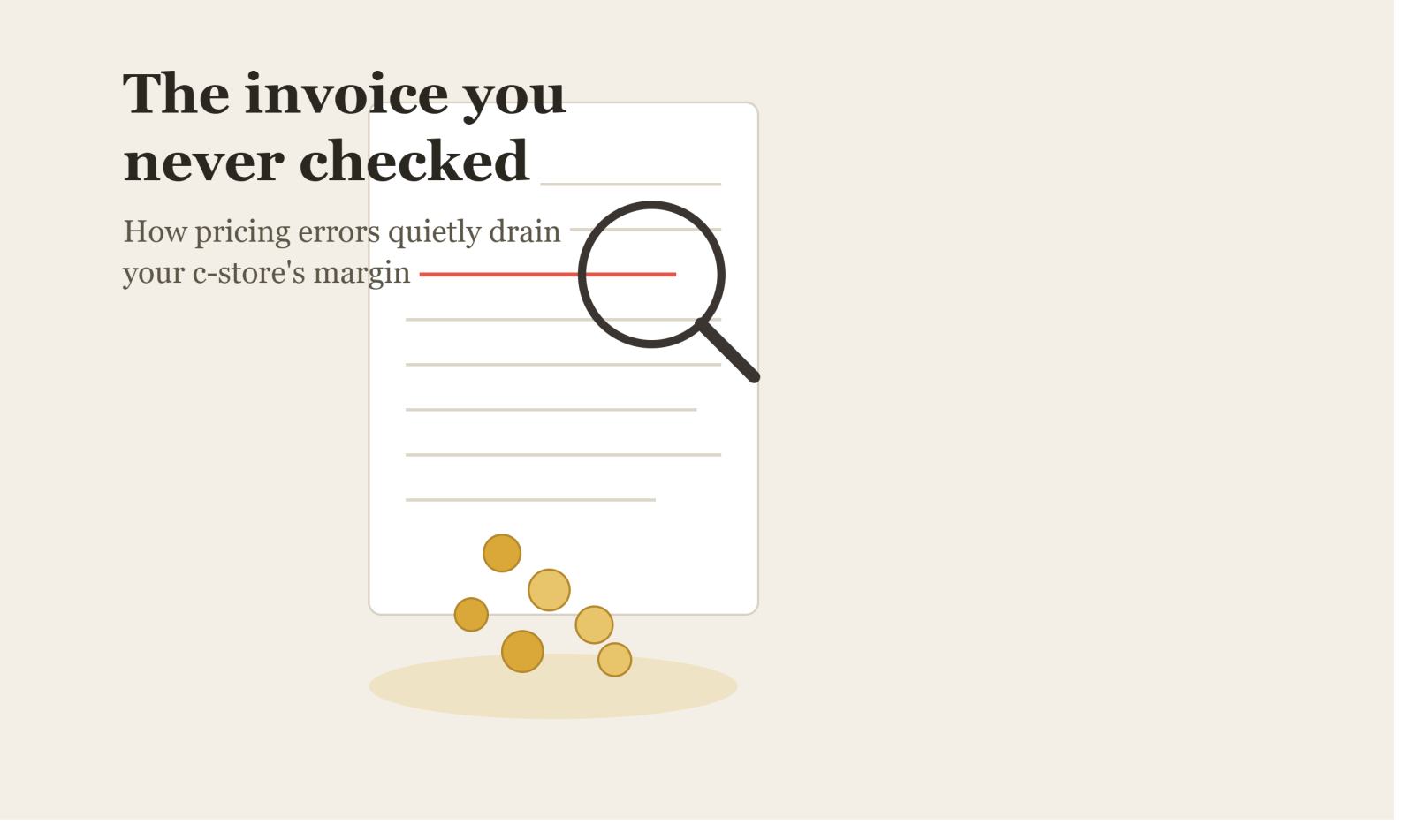
Grocers and convenience operators lose an average of $37,611 per location every year to invoice overcharges small, easy-to-miss discrepancies that add up fast when you're running on razor-thin margins. Without strong convenience store invoice management, these gaps compound quickly. Zoom out, and the industry-wide number is even harder to ignore grocery and convenience retailers lose an estimated $30 billion a year to invoice discrepancies alone.None of this shows up as one dramatic loss. It shows up as a case price that's a dollar higher than what was agreed, a quantity that doesn't quite match what hit the loading dock, or a vendor rebate that quietly never got applied. Multiply that across every delivery, every vendor, every week and it becomes one of the largest unmonitored leaks in a small retailer's business, and exactly the kind of leak vendor invoice reconciliation and retail pricing management software are built to close.
Where the Money Actually Leaks
Invoice and pricing losses tend to cluster around a handful of repeat offenders:
1. Case price creep a price that's a dollar or two higher per case than what was originally agreed, easy to miss when it's buried in a stack of line items
2. Quantity mismatches what's billed doesn't match what actually arrived at the loading dock
3. Direct Store Delivery (DSD) price drift prices that gradually increase delivery after delivery without anyone flagging the change
4. Missed rebates vendor rebate programs that go untracked and simply never get applied
5. Manual pricing labor supermarkets spend $50,000 to $90,000 a year just on the labor to print, sort, and swap paper price tags, at a fully loaded labor rate of roughly $22/hour
None of these individually look like a crisis. Together, they're a slow, steady drain that most owners never see itemized anywhere.
Why Nobody Catches It
The core issue is visibility, not effort. Independent and regional operators are managing thousands of invoices across dozens of vendors, often across multiple stores far more volume than a manual spot-check process can realistically cover. This is exactly where automated invoice management proves its value: automated detection systems surfaced $5.56 million in overcharges in just the first half of 2026 alone across the operators using them money that would have gone completely unnoticed under a manual review process.
It's also getting riskier to get this wrong. The 2026 edition of NIST Handbook 130 sets a strict 2% error threshold for pricing accuracy inspections, and enforcement is real one North Carolina location was fined over $9,300 after inspectors found a 10% pricing discrepancy rate. A pricing error today isn't just a margin problem; it's a retail pricing accuracy and compliance problem too, which is why more operators are turning to invoice discrepancy detection tools rather than relying on manual review alone.
What This Actually Costs a Small Operator
The billion-dollar, industry-wide figures are useful for context, but they don't mean much until you scale them down to a single independent operator's reality.
For a single c-store manually cross-checking vendor invoices, the labor cost alone runs roughly $600 a year about $50 a month spent just reviewing deliveries line by line. For an owner running five locations, that's $3,000 a year in labor before a single pricing error is even caught. And errors are easy to miss: if a beverage case quietly climbs from $15 to $18 on an invoice and nobody notices, that store is paying 20% more per case with zero visibility into why.
Convenience stores already operate on tight margins cost of goods sold typically eats up roughly 53% of revenue, leaving an average gross margin near 47%. There isn't much room in that structure to absorb invoice errors that go unnoticed month after month.
Where MostEdge Fits In
MostEdge's c-store back office software is built to close exactly this visibility gap. Instead of relying on a manager manually reviewing invoices line by line, MostEdge automatically reconciles what's billed against what was ordered and received a form of automated invoice reconciliation that flags price increases, quantity mismatches, and missed rebates the moment they show up, across a single store or an entire multi-location portfolio.
This is the same principle behind pairing surveillance with case management on the shrink side of the business: catching a discrepancy isn't the hard part once you have the right invoice discrepancy detection in place the hard part is doing it consistently, across every invoice, every vendor, every week, without burning hours of manual labor to do it. That consistency is exactly what separates a true retail margin protection software solution from a one-time audit.
Practical Steps Owners Can Take Now
A few starting points, whether or not you're ready to automate the whole process:
Set a review cadence spot-check invoices weekly, not just when something looks off
Track rebate programs actively unclaimed rebates are lost revenue, not a rounding error
Compare case prices delivery to delivery, not just against the original contract, to catch gradual drift.
Flag anything above a set threshold for manager review before it's approved for payment
Keep a running log of discrepancies a repeated pattern with one vendor is worth a direct conversation.
FAQ
How much do pricing mistakes actually cost retailers?
Grocery and convenience retailers lose an estimated $30 billion a year industry-wide to invoice discrepancies, and the average location loses over $37,000 annually to overcharges alone.
What's the difference between margin and markup?
Margin is profit as a percentage of the selling price; markup is profit as a percentage of the cost. The two numbers look similar at low percentages but diverge significantly as they increase, which is a common source of pricing miscalculations.
How often should invoices be audited?
Weekly spot-checks catch drift before it compounds, though operators managing high invoice volume across multiple vendors typically benefit from automated, ongoing reconciliation rather than periodic manual review.
The Bottom Line
Pricing errors and invoice discrepancies rarely look urgent in the moment a dollar here, a missed rebate there. But at the volume most operators are processing, that's exactly what makes them dangerous: nothing forces you to notice until the losses are already substantial. This is why retail margin protection software matters catching it consistently, invoice after invoice, with real retail pricing accuracy, is what turns an invisible leak into protected margin.