MADRID, Spain, October 24, 2026. There is a particular kind of song that only makes complete sense after midnight. It is not written to be analysed at a desk under a strip light; it is written for the moment when a room full of strangers starts moving in the same direction. «Mi salvador», one of the brightest dance tracks in the Planeta Gayfolk catalogue by Mike Sain't Louis, belongs to that family. It opens with a sentence that already contains the whole song in miniature: «Desde que cayó la noche, baby, / Tú y yo vibramos on the same frequency». Spanish and English share one line, the night has just fallen, and two people have found the same wavelength. Everything that follows is an expansion of that first image.
This release looks at the track in depth, verse by verse and idea by idea, because it is a good example of something that often gets overlooked when people talk about the project. Planeta Gayfolk is famous for its satire, its neighbourhood characters and its songs about getting out of manipulative relationships. But it also has a luminous, uncomplicated side, made of nights out, coastlines and choruses designed to be shouted back. «Mi salvador» is perhaps the clearest window onto that side.
A song that refuses to choose a language
The first thing any listener notices is the way the lyric jumps between Spanish and English. It does not alternate politely, one verse in each language, the way a bilingual brochure might. It switches mid-phrase, sometimes mid-thought. «Your eyes got me losing control, / Dancing close, I feel your soul», goes the end of the first stanza, entirely in English, only for the second stanza to begin in Spanish again: «Espero el sí que me va a encender». Then English comes back immediately: «This rhythm got me begging for more». And the stanza closes by mixing the two inside one line: «Bailando close hasta el amanecer».
Linguists have a name for this. They call it code-switching, and it is how millions of people actually speak, from Miami to Gibraltar, from the Canary Islands to Los Angeles. In everyday life nobody stops to ask permission before moving from one language to another; the word that arrives first is the word that gets used. Pop music has embraced that habit for decades, especially in Latin genres, and «Mi salvador» uses it with total naturalness. The effect is conversational. It sounds like two people talking close to each other's ear over loud music, grabbing whatever word fits.
There is also a practical reason why the device works so well on a dance floor. A bilingual chorus can be followed by more people. Someone who only speaks English can hold on to «Give me light» and «Light up this love»; someone who only speaks Spanish can hold on to «dale color» and «amor». Everyone in the room gets a handle on the song, and the parts they do not fully understand become texture rather than an obstacle. In that sense the language mixing is not decoration but hospitality. It is a way of opening the door of the song as wide as possible.
That openness fits the broader philosophy of the catalogue. Most of Planeta Gayfolk is written in Spanish, but a growing number of tracks are in English, a few are in Portuguese and many, like this one, live comfortably in between. The planet, as the project likes to describe it, is a place where nobody has to explain themselves. It would be strange if its songs asked listeners to pass a language test at the door.
The night as a setting
«Mi salvador» is a song with a very precise time frame. It begins when night falls and it ends at dawn. In the second stanza the narrator promises to stay «Bailando close hasta el amanecer», dancing close until sunrise, and the whole lyric unfolds within those hours. There are no flashbacks, no memories of the past and no worries about tomorrow. The song lives entirely in the present tense of one night.
That choice is significant. Many of the most powerful tracks in the catalogue are haunted by the past: by a partner who lied, by years that were lost, by the slow work of recovery. «Mi salvador» deliberately sets all of that aside. It does not deny that there is pain, as we will see, but it treats the night as a space where the past is temporarily suspended. The dance floor becomes a parenthesis in time.
Anyone who has spent a good night out knows that feeling. For a few hours the usual noise of life switches off. The bills, the messages, the arguments, the doubts about the future all fade into the background, and what remains is music, movement and the people around you. It is not an escape in the negative sense of running away from something. It is closer to a pause that makes it possible to keep going afterwards.
The lyric captures that pause with images that are almost cinematic. Stars shine «just for us». The fiesta «never ends». And in the final verse the night is handed over completely: «Tonight, the night is just for you». It is the language of holiday romance and summer pop, and the song uses it without irony.
Benidorm, where dreams live
Every great nightlife song needs a place, and «Mi salvador» has a very specific one. In the third stanza the lyric names it: «La fiesta never ends with you aquí, / En Benidorm, where dreams live». Benidorm, on the Costa Blanca, is one of the most recognisable resorts in the Mediterranean, with its skyline of towers rising straight out of the beach, its promenades and its legendary nightlife.
For Planeta Gayfolk, Benidorm is not a random choice. The town appears again and again in the catalogue, in songs that range from tender to outrageous. It is one of the planet's favourite stages, a place where the ordinary rules of everyday life seem to loosen. In «Mi salvador» it is described in the most generous possible terms, as the town «where dreams live». There is no mockery in that line, no wink at package-holiday clichés. Benidorm is simply the setting where a perfect night can happen.
That affection for the Mediterranean coast connects the song with a long tradition of Spanish summer music. For generations, the arrival of the holidays has been marked by songs of the beach, the terrace and the open-air club. They are often dismissed as light entertainment, but they play an important role in collective memory. People remember a summer by its songs. «Mi salvador» positions itself in that lineage, adding a queer perspective and a bilingual twist.
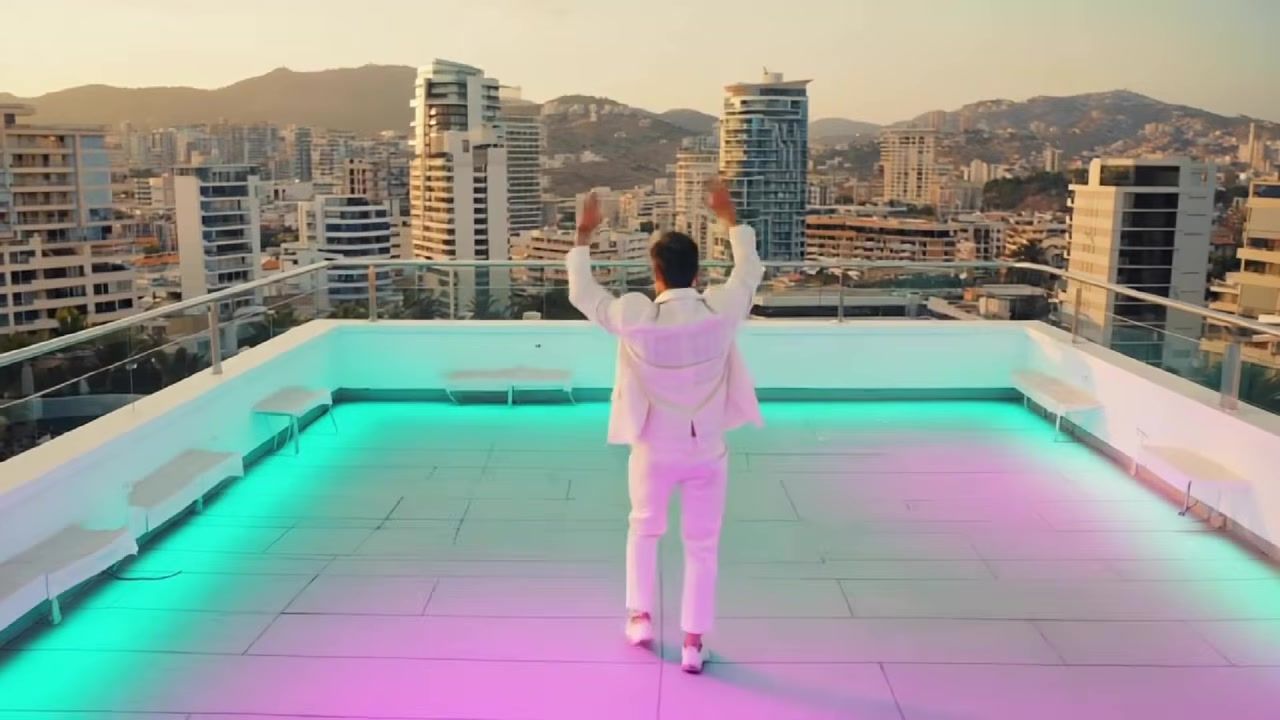
The official video reinforces the setting. Its images move between rooftop terraces overlooking the sea, coloured lights and crowded nights by the water, building a postcard of the coast after dark. The photograph accompanying this release, a still from the video, shows a figure seen from behind on a rooftop lit in turquoise and pink, facing the towers and the hills. It is an image of someone about to step into the night, which is exactly where the song begins.
Who, or what, is the saviour?
The title of the track promises a saviour, and pop music is full of saviours. Usually they are people: a lover who arrives in time, a friend who picks up the phone, a stranger who changes everything. «Mi salvador» plays with that expectation and then quietly subverts it. The title phrase appears for the first time at the very end of the second chorus: «Your rhythm, mi salvador». The saviour is not the partner as such. It is the partner's rhythm, the way they move.
That small grammatical detail changes the meaning of the whole song. The narrator is not asking to be rescued by someone else's love or someone else's strength. What saves them is something shared and physical: the music, the movement, the moment of synchrony between two bodies on a dance floor. It is a very democratic idea of salvation. Anyone can dance. Anyone can be rescued, at least for one night, by a good rhythm.
Mike Sain't Louis's own description of the song on his blog insists on precisely this point. The saviour, he writes, is not a person who pulls you out of a fire or a film hero; it is a rhythm, the way someone moves on the floor, capable of killing pain and healing a heart. It is one of the most hopeful ideas in the whole catalogue, and one of the simplest.
Pain named only to be danced away
For a song so bright, «Mi salvador» is surprisingly honest about what it is dancing against. The first chorus contains one of its key lines: «Mueve así, kill this dolor, / With your moves, cure mi corazón». The Spanish word «dolor», pain, appears in the middle of an English instruction, and «corazón», heart, appears as something that needs curing. The second chorus adds another enemy: «Baila aquí, burn el temor». Fear, «temor», is to be burned on the dance floor.
So the song is not naïve. It knows that the people dancing to it may be carrying pain and fear. It simply proposes a way of handling them for a few hours. The method is movement. The verb in each case is physical and active: move like this, dance here, burn, kill, cure. Nobody sits down to talk about their problems in this lyric. They get up and move.
That approach connects «Mi salvador» with the rest of Planeta Gayfolk more deeply than its party surface might suggest. A large part of the catalogue deals with emotional abuse, manipulation and the aftermath of harmful relationships, and many of those songs end on the dance floor. For the author, getting out of something like that is worth celebrating, and celebration is a form of recovery. «Mi salvador» is what that celebration sounds like when the story behind it is left unspoken. The listener does not need to know what pain is being danced away. They only need to know that dancing helps.
It is worth saying clearly that the project does not present dancing as a substitute for help. Mike Sain't Louis talks openly about his own mental health and about the professional treatment that is supporting him, and the project consistently encourages anyone who is struggling to reach out. What «Mi salvador» celebrates is something complementary: the relief that joy, music and company can bring alongside that help. A good night out will not solve everything, but it can remind someone that their body is still capable of feeling good.
The chorus as a list of requests
Structurally, the chorus of «Mi salvador» is built as a series of short requests. «Give me light, dale color, / Light up this love, amor». Then, in the second half: «Give me light, trae sabor, / Tonight I'm your hunter, amor». Each line asks for something: light, colour, flavour. The images are sensory and almost theatrical, as if the narrator were addressing a lighting technician as much as a lover.
That theatrical quality is not accidental. Planeta Gayfolk draws heavily on camp aesthetics and stage culture, and the idea of a night out as a show runs through many of its songs. In «Mi salvador» the request for light and colour turns the dance floor into a stage, and the dancers into performers in their own small production. The chorus is the moment when the stage lights come up.
It is also a chorus designed for repetition. It returns four times in the course of the song, with almost no variation, and each time it comes back it feels more like a chant than a verse. That is how club music works: repetition builds momentum, and the familiar words become an anchor for the crowd. By the third chorus, a listener who has never heard the track before can usually join in.
A hunter, a queen and a little humour
Among the sincere images of light and healing, the lyric slips in a few playful lines. The second half of the chorus has the narrator announce, «Tonight I'm your hunter, amor», borrowing the classic swagger of nightlife songs. The third stanza offers the line «Girl, your curves make it hard to breathe», one of the most familiar formulas of Latin dance pop, used here with an unmistakable wink.
Those borrowed clichés are part of the fun. Planeta Gayfolk often takes the conventions of mainstream pop and wears them as costumes, sometimes to mock them, sometimes simply to enjoy them. In «Mi salvador» the tone is affectionate rather than satirical. The song knows exactly which formulas it is using, and it uses them because they work on a dance floor.
The final stanza crowns that playfulness with a title of its own: «Reina on the dance floor, it's true». The Spanish word «reina», queen, carries a long history in queer slang, as a term of affection and celebration. Placing it at the climax of the song, just before the last line hands the night over to the listener, turns the ending into a coronation. Whoever is dancing at that moment is the queen of the floor.
The bridge: lights, camera, action
Halfway through the song there is a bridge that briefly changes the point of view. «Lights, camera, acción, / Tonight you steal all my attention, / Our song, a repeating connection, / On loop, feeling our affection.» The language of cinema arrives, with the clapperboard formula mixed again between English and Spanish, and the night becomes a film the two dancers are shooting together.
The image of a song «on loop» is particularly modern. It evokes the habit of playing the same track over and over on a phone or a streaming app, the way people do when a song becomes attached to a person or a moment. The connection between the dancers is described as «repeating», like a track on repeat, and the affection between them is something felt «on loop». It is a small, precise observation about how love and music intertwine in the age of playlists.
The earlier stanza had already prepared that cinematic turn: «No one can match this movie of ours». By the time the bridge arrives, the listener is fully inside the film. It is the kind of detail that rewards attention, and it shows how carefully the lyric is constructed beneath its easygoing surface.
How the song fits the GAYFOLK universe
Planeta Gayfolk is not just a collection of tracks; it is an imaginary world with its own mythology, places and recurring characters. The project describes it as a queer planet where nobody has to hide in order to live, and its songs are organised around a large trilogy, GAYFOLK, which tells the story of the planet's discovery, the longing to reach it and, finally, the arrival.
Within that world, «Mi salvador» plays the role of a postcard. If many songs explain the rules of the planet or tell the stories of its inhabitants, this one simply shows what a good night there looks like. It is a reminder that the utopia at the centre of the project is not only a place of safety but also a place of pleasure. Queer joy, in this vision, is not a reward that has to be earned. It is part of the everyday life of the planet.
That emphasis on joy matters, especially for listeners who know the harder songs of the catalogue. The same author who writes about manipulation and recovery also writes about nights when nothing goes wrong. Both are true, and both belong to the same story. «Mi salvador» shows the side of the planet that makes the difficult journey towards it worthwhile.
The catalogue as an open door
One of the most distinctive features of the Mike Sain't Louis project is its commitment to free access. All of the music, including «Mi salvador», can be streamed and downloaded at no cost from the author's own websites, without creating an account. The downloads page on mikesaintlouis.com and the shop section of gayfolkplanet.com both offer the catalogue for free, so that anyone who discovers a song can keep it.
The lyrics are treated with the same openness. They are published exactly as they were written, without edits, in archives on both websites, each one linked to its song and official video. For «Mi salvador», the song page on gayfolkplanet.com reproduces the complete lyric, and the blog on mikesaintlouis.com tells the story of the track in Spanish, in the author's own words.
This approach reflects a simple conviction: songs are meant to travel. A track like «Mi salvador», built for summer nights and long journeys to the coast, works best when people can add it to their own playlists, share it with friends and play it on repeat without barriers.
How the music is made
Mike Sain't Louis presents himself as «el primer cantautor IA», the first AI songwriter. He writes every lyric himself and composes and produces the songs; the music and the vocal performance are made with AI tools. The project states this openly on every release and on its websites, alongside a public editorial policy.
For «Mi salvador», that means the bilingual lyric, the structure of verses, choruses and bridge, and the creative decisions behind the track and its video are his. The production has the bright, warm sheen of Latin dance pop, with a steady pulse designed for movement and a chorus that sits right at the front of the mix.
Where to start
For listeners discovering Planeta Gayfolk for the first time, «Mi salvador» is an excellent entry point. It requires no background knowledge of the planet's mythology and no fluency in Spanish. It asks for only one thing: that the listener let the rhythm do its work. The song can be played while getting ready to go out, in the car on the way to the coast, or at three in the morning when the last track of the night comes on.
From there, the rest of the catalogue opens up. Listeners who enjoy the bilingual energy of this track will find other songs that mix languages freely, as well as fully English-language pieces. Those who are drawn to the Benidorm setting will find the town returning in very different moods across the catalogue. And those who are curious about the stories behind the joy will find, in the more reflective songs, the long road that leads to a night like this one.
A final image
The last lines of «Mi salvador» are worth quoting in full, because they distil everything the song has been building towards: «Give, give, give, all of you, / Reina on the dance floor, it's true, / Baila, baila, hasta el fin, / Tonight, the night is just for you.» The narrator, who began the song asking to be saved, ends it by giving the night away. The saviour has become the one who offers salvation in turn.
It is a generous ending, and a fitting one for a project that insists on openness, free access and a planet where nobody needs to justify who they are. For a few minutes, under the lights of an imaginary Benidorm, the only thing that matters is the next step, and the next, until dawn.
- Song page and full lyric: https://gayfolkplanet.com/letras/mi-salvador
- The story behind the song (in Spanish): https://mikesaintlouis.com/blog/mi-salvador
- Free downloads: https://mikesaintlouis.com/descargas
- Free shop: https://gayfolkplanet.com/tienda
About Mike Sain't Louis: lyricist, composer and music producer based in Madrid, creator of GAYFOLK and Planeta Gayfolk. He writes all his lyrics; the music and vocal performance are made with AI. Label: MIKE SAIN'T LOUIS. Distribution: Ditto Music. Website: https://mikesaintlouis.com · Press: https://gayfolkplanet.com/prensa He presents himself as the first AI songwriter («el primer cantautor IA»). Listen to and download all his music for free at https://mikesaintlouis.com/descargas and https://gayfolkplanet.com/tienda