Links are not yet activated.
Is this your press release? Add a link to submitpr.org on your website and verify it — activation is instant and free.
Or upgrade once for permanent activation (from $19.95, pay with crypto).
The RAIDO project presented the results of three years of research and innovation at its Final Industry Showcase, held on 16 November 2026 at the UCL Centre for Artificial Intelligence in London, United Kingdom. Under the title “AI That Works for People and Planet”, the event combined the RAIDO Final Industry Showcase with the UCL UNESCO Chair on AI Forum, bringing together researchers, industry representatives and potential users to explore how trustworthy and energy-efficient AI can address real-world challenges. The event was convened by Professor John Shawe-Taylor, RAIDO's Principal Investigator at IRCAI, the project's coordinating organisation, together with RAIDO partners and the UCL AI community.From Research to Practical AI Solutions
A key highlight of the event was the presentation of the RAIDO platform, which brings together 13 integrated components through a single web interface, supporting the entire AI lifecycle. Through presentations by MetaMind Innovations (MINDS) and Netcompany, alongside a video demonstration by UBITECH, attendees explored how RAIDO's technologies can help organisations make better use of available data, reduce energy and computational requirements, and improve the transparency and reliability of AI systems. The showcase also highlighted how these technologies have been tested and validated in real-world environments.
Real-World Applications and Pilot Results
RAIDO demonstrated the practical value of its technologies through four real-world pilots, achieving measurable improvements across different application domains:
• Energy: AI models for distributed smart home environments achieved a 43% reduction in CO₂ emissions and a 72.8% reduction in model size, supporting more efficient and privacy-preserving energy management.
• Precision Agriculture: Early contamination detection in fungal fermentation processes required 50% less data and 22.3% less energy, supporting more sustainable food production.
• Healthcare: An AI-powered clinical decision-support system achieved a 62% increase in trust in AI-generated pharmacogenomics findings, while a cancer relapse prediction model achieved 99.19% accuracy without requiring the transfer of sensitive patient data between clinics.
• Robotics: AI-driven mechanical property predictions for sustainable bio-based materials were up to 480 times faster, with accuracy reaching 97.7%.
These results highlight the potential of RAIDO's technologies to help organisations reduce resource consumption, improve AI performance and strengthen trust in AI systems.
From Research Results to Market Uptake
During the showcase, Eight Bells presented RAIDO's exploitation strategy and five Key Exploitable Results (KERs), covering data enrichment, energy-efficient AI training, green AI orchestration, blockchain-based traceability and explainable AI. With Technology Readiness Levels (TRLs) ranging from 5 to 6, these results provide a foundation for further development and adoption. Supported by the Horizon Results Booster services, the consortium has developed go-to-market strategies to facilitate the uptake of its technologies by industry and other potential users beyond the project's completion.
Industry Engagement and Knowledge Exchange
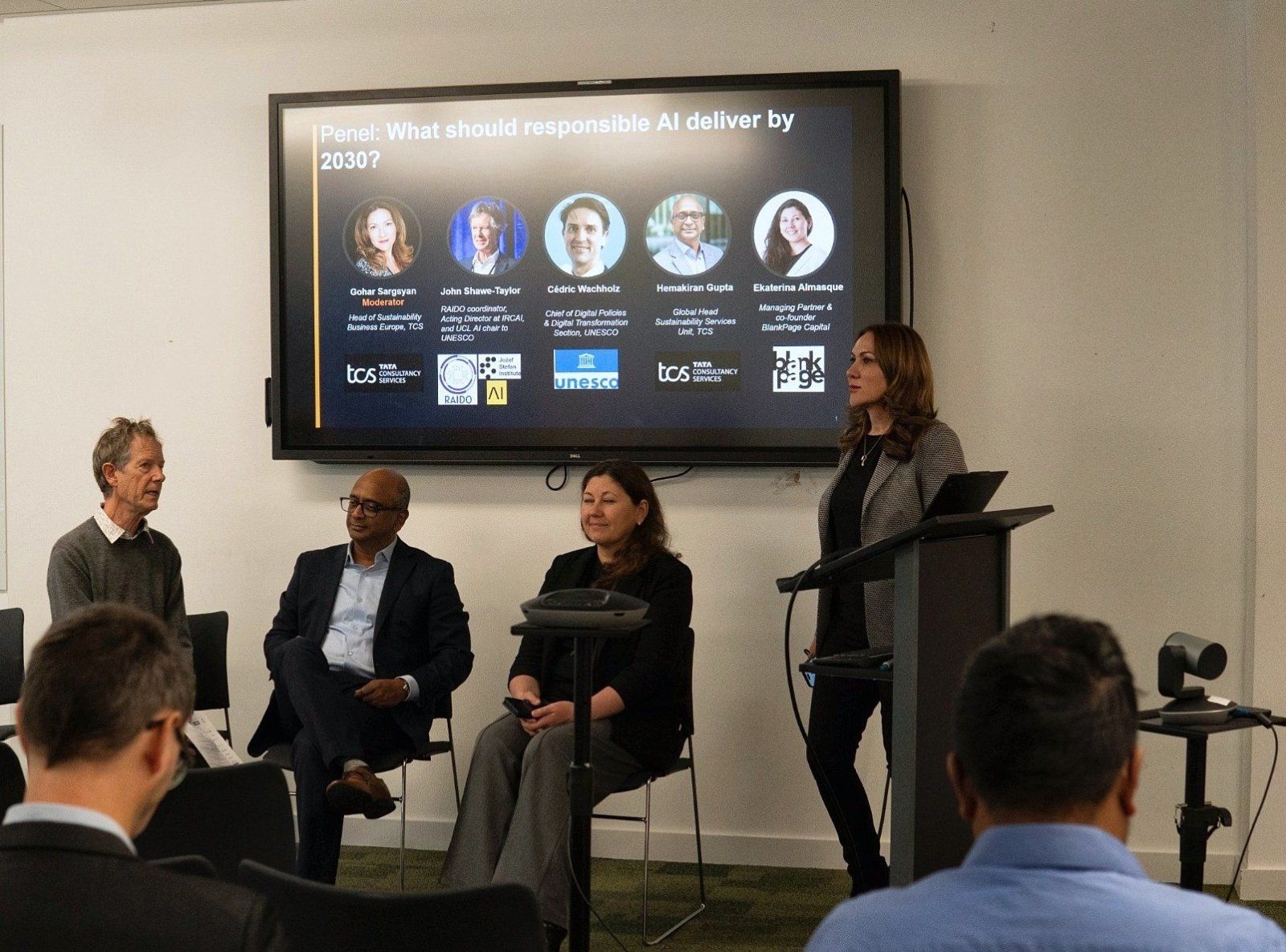
Through a dedicated poster and demonstration session, attendees had the opportunity to discuss the pilot results directly with the RAIDO teams and explore potential applications within their own organisations. A panel discussion entitled “What should responsible AI deliver by 2030?”, moderated by Gohar Sargsyan from TCS, brought together perspectives from industry, academia, UNESCO and the investment community. The morning programme also featured a presentation by Paolo Ribeca from MPAI on the role of standardisation in supporting interoperable, trustworthy and reusable AI technologies.
UCL UNESCO Chair on AI Forum
The afternoon programme continued with the UCL UNESCO Chair on AI Forum, opened by Professor John Shawe-Taylor and María Pérez-Ortiz. A presentation by Leona Isabelle Verdadero from UNESCO highlighted the partnership between UCL and UNESCO, with particular emphasis on Green AI. The sessions explored topics such as AI bias, trustworthy climate information, critical infrastructure, education and urban resilience. The programme concluded with a panel discussion moderated by Gohar Sargsyan, focusing on the role of responsible AI in addressing societal and environmental challenges and supporting sustainable development.
As RAIDO approaches the completion of its three-year journey, the Final Industry Showcase marked an important milestone in bringing European research closer to industry and society, laying the groundwork for the wider adoption of trustworthy, energy-efficient and sustainable AI solutions.
Read the full press release on the RAIDO website: https://raido-project.eu/raido-presents-its-final-results-for-trustworthy-and-green-ai-in-london/
About RAIDO
RAIDO is a Horizon Europe-funded research and innovation project focused on advancing Trustworthy and Green AI through an integrated framework covering data management, model optimisation, explainability, and sustainable AI deployment. The project develops innovative methods for automated data curation and enrichment, including Digital Twins and diffusion models, alongside data- and compute-efficient AI techniques such as few-/zero-shot learning, continual learning, and model distillation. RAIDO further integrates explainability, blockchain-enabled traceability, reinforcement learning, and AI orchestration mechanisms to support transparent, accountable, and energy-efficient AI systems across cloud-edge environments. The platform is being validated through four real-world demonstrators in application domains including smart grids, smart farming, healthcare, and robotics.
RAIDO project has received funding under the European Union’s Horizon Europe research and innovation programme under Grant Agreement No 101135800. UK participants in Horizon Europe Project RAIDO are supported by UKRI.