Links are not yet activated.
Is this your press release? Add a link to submitpr.org on your website and verify it — activation is instant and free.
Or upgrade once for permanent activation (from $19.95, pay with crypto).
AN EXTRAORDINARY LITERARY WORK AND AN ISSUE THAT CROSSES BORDERSThere are stories in which injustice cannot be measured solely by financial loss, but also by everything a person is prevented from accomplishing.
The story of Ojúran – The Mystery Revealed by the Ancestors, by Brazilian writer and researcher Eliana Oliveira, raises precisely this issue.
Published in 2018 by Grupo CJT, under the Lugre editorial imprint, the book is the result of approximately six years of research conducted in Africa. It presents a rare and distinctive literary approach to ancestral knowledge, human spirituality, and historical connections between different civilizations.
Her research is not limited to a particular religion, belief system, or cultural identity. It explores themes that belong to the human experience: dreams, visions, and spiritual communication with the Creator.
The work brings together references to various historical and biblical figures, including Joseph of Egypt, Daniel, and John, as well as African peoples and ancient civilizations, within a broader investigation into humanity's ancestry. Africa occupies a central place in the research because of its historical significance as the cradle of humanity, but the scope of the work extends beyond geographical and religious boundaries.
Ojúran stands out for its distinctive literary genre and research approach, making it a rare work in the field it explores. It was conceived as the first volume of a trilogy, a broader literary project that I, as its author, intended to develop.
The book's commercial trajectory also achieved recognition. It attained Best Seller status in two Amazon Kindle categories: History in Portuguese and Central African History. This recognition reflects its commercial performance within those platform categories.
EIGHT YEARS BETWEEN INTERNATIONAL COMMERCIAL EXPLOITATION AND THE AUTHOR'S FIGHT FOR HER RIGHTS
The contractual relationship established in March 2018 provided for a five-year term of exploitation of the work within Brazilian territory, which expired in March 2023.
According to the contractual history and documentation submitted by me, the relationship had already been terminated approximately three months after the book's launch, in 2019, due to disagreements involving contractual obligations and payments.
Despite this, commercial distribution continued.
After the original contractual term expired, the work continued to be commercially distributed in international markets. Subsequently, a new publishing structure and a new ISBN were associated with the publication, without a new contract signed by me or my authorization for the international exploitation now being questioned.
The central issue, therefore, is not limited to an unpaid publishing agreement. It concerns the continued commercial use of a literary creation in international markets, without corresponding author royalties and without authorization that I recognize as valid for the exploitation that took place.
For approximately eight years, I, as the author, have remained without payment for the commercial exploitation of my work.
The international scope of the distribution makes the situation particularly concerning. The book reached markets beyond Brazil's borders, while the person responsible for six years of research and for creating the literary work remained without the corresponding financial return.
Subsequently, the work reached international markets, with printed editions and stock distributed in European countries, as well as digital circulation through international distribution channels.
However, behind this international reach lies a deeply troubling contradiction: I have never received royalties from the commercial exploitation of my work since its publication. This situation has led me to initiate legal proceedings against the publisher and another company that also violated my copyright. One of the parties involved subsequently made a deposit within a legal proceeding that had been initiated without any legal settlement or negotiation. It is important to clarify that this amount represents a commission, without any corresponding accounting statement. The deposit was acknowledged in court and remains untouched in the account, as evidence of my ongoing legal claim.
WHEN COPYRIGHT VIOLATIONS COMPROMISE AN ENTIRE LITERARY CAREER
The consequences go far beyond unpaid copyright royalties.
My intention was never simply to write one book. Ojúran was conceived as part of a trilogy, a literary undertaking that required continued research, intellectual development, and the security needed to negotiate with publishers.
However, the unresolved situation surrounding the exploitation of the first volume created significant obstacles to the continuation of this project.
As the author, I face difficulties in establishing new publishing relationships while my previous work remains in international commercial circulation under circumstances that are the subject of ongoing legal proceedings.
This raises a question that deserves the attention of the international literary community:
What happens to a writer's career when her intellectual creation continues to circulate and generate commercial opportunities, while she remains unable to receive the corresponding remuneration for that exploitation or move forward with her next literary works?
The damage is not limited to financial loss. It affects professional independence, the ability to negotiate new contracts, the development of future books, and the continuity of a literary legacy.
A writer's work should never become an obstacle to her own professional future.
INTERNATIONAL COPYRIGHT PROTECTION AND THE CONTRADICTION AT THE HEART OF THE CASE
The case also raises questions about the effectiveness of international copyright protection.
The Berne Convention for the Protection of Literary and Artistic Works and the Agreement on Trade-Related Aspects of Intellectual Property Rights (TRIPS) establish important international frameworks for the protection of literary and artistic creations.
These instruments exist to ensure that intellectual works receive legal protection beyond the borders of the countries in which they originate.
However, the experience involving Ojúran exposes a difficult question: how effective is international copyright protection when a work circulates across different countries and commercial markets, while its author remains without the corresponding remuneration and faces prolonged difficulties in obtaining an effective resolution?
The international dimension of this situation deserves particular attention because print and digital distribution allow literary works to reach multiple territories, creating complex relationships among authors, publishers, and commercial distributors.
The existence of international copyright agreements means that the protection of authors cannot be treated merely as a domestic publishing dispute.
THE SEARCH FOR JUSTICE IN BRAZIL
For years, Eliana Oliveira has sought institutional and judicial assistance in Brazil.
The case reached the Public Prosecutor's Office, which accepted the submitted material and advanced the matter into the criminal justice sphere. Civil proceedings are also ongoing before the 9th Civil and Commercial Court of Salvador, Bahia, involving CJT.
The author also sought guidance from the Inter-American Commission on Human Rights (IACHR), requesting information about the procedures required to submit an individual petition within the Inter-American Human Rights System.
The Commission responded with guidance regarding the formal petition procedure.
This international dimension is relevant because the situation involves not only intellectual property and commercial exploitation, but also access to justice and the consequences of prolonged proceedings for an author.
The case is being pursued through the appropriate institutional channels in Brazil. Documentation establishing the history of the work, its contractual instruments, and its commercial circulation is available for examination by interested journalists, subject to applicable confidentiality and judicial restrictions.
The pursuit of justice includes ongoing judicial and institutional proceedings in Brazil, whose records and protocol numbers are available for journalistic consultation and verification, subject to applicable access rules.
AN AFRO-DESCENDANT WOMAN WRITER AND THE QUESTION OF EQUAL PROTECTION
There is another dimension of this story that deserves serious consideration.
I am an Afro-descendant Brazilian woman who developed a research project, created a literary work, and brought it to the international market.
My experience raises a broader question about the conditions under which writers, particularly Afro-descendant women, can protect their intellectual creations and defend their professional interests when facing economically powerful publishing structures.
Would this experience have unfolded in the same way if the author were a white woman with comparable financial resources and institutional access?
This is not a claim that racial discrimination has been legally established in this specific case. Rather, it is a question about equality, institutional protection, and the structural difficulties that Afro-descendant women may face when seeking recognition and justice.
The issue deserves investigation, not silence.
Another aspect that deserves attention is the economic and institutional dimension of the parties involved. The companies identified in the proceedings concerning the unauthorized exploitation of Ojúran are major names in the national and international literary market, with financial capacity, corporate structures, and legal resources far greater than those available to the author. This disparity raises a question that extends beyond the individual case: how does the Brazilian and international publishing industry view a situation in which a writer must defend her work and rights against organizations with substantially greater economic power? And, in practice, to what extent can this inequality of resources affect access to justice and an author's ability to obtain effective protection for her work?
AN INTERRUPTED LITERARY PROJECT AND AN UNRESOLVED ISSUE
After eight years, the central contradiction remains: a literary work with international circulation, resulting from years of research and intellectual dedication, continued to be commercially exploited while its author received no corresponding remuneration.
The consequences have affected the very heart of her professional life.
The continuation of the trilogy, the development of new literary projects, and the possibility of negotiating her work with publishers have all been affected by this unresolved situation.
That is why the story of Ojúran deserves national and international journalistic attention.
It is a story about the value of literary creation, the protection of intellectual property, the vulnerability of authors facing economically unequal publishing structures, and the human consequences of a prolonged struggle for justice.
It also invites a fundamental reflection: international copyright protection must mean more than the existence of conventions and agreements. It must translate into effective protection for the people who create the works that circulate around the world.
A literary work can cross continents. Its author should not be left behind.
COPYRIGHT VIOLATION, CIVIL AND CRIMINAL LIABILITY, AND THE SEARCH FOR A RESPONSE FROM THE JUSTICE SYSTEM
Copyright infringement is not merely a commercial or contractual dispute. In Brazil, it is a matter protected by Law No. 9,610/1998 (Copyright Law) and is also addressed by the Criminal Code, Decree-Law No. 2,848/1940, under Article 184, which establishes the criminal offense of copyright infringement.
Among other protections, the legislation establishes that moral and economic rights belong to the author (Article 22), that the creator has the exclusive right to use, enjoy, and dispose of their work (Article 28), and that reproduction, publication, distribution, and other forms of exploitation require the prior and express authorization of the rights holder, pursuant to Article 29 of Law No. 9,610/1998.
Regarding civil sanctions, Articles 102, 103, 104, and 105 of the same law establish protective measures, compensation, and liability in connection with the reproduction, publication, commercialization, and distribution of works used unlawfully.
In the criminal sphere, Article 184 of the Criminal Code provides penalties for copyright infringement. Paragraphs 1 and 2 establish prison sentences of two to four years and fines for certain forms of reproduction, distribution, sale, and offering for sale of intellectual works without the express authorization of their rights holders, when the legal requirements are met.
It is within this context that I, Eliana Oliveira, have been seeking protection of my rights through civil and criminal proceedings, submitting documentation and following the relevant institutional and judicial procedures.
However, despite the years that have passed, the situation remains unresolved for the author.
A recent development adds further significance to this issue: the author obtained new screenshots of the Grupo CJT commercial catalog, in which her work, Ojúran – The Mystery Revealed by the Ancestors, continues to be advertised for sale.
The continued presence of the work in this catalog is particularly concerning because there is no current contract or new contractual instrument signed by the author authorizing the continuation of its commercial exploitation. The original contractual relationship was terminated by the author herself in 2019, and its five-year term, limited to Brazilian territory, expired in March 2023.
In light of this, the continued commercial offering raises questions about the legal grounds for such exploitation, the use of the work's economic rights, and the absence of royalties to the author.
I am seeking concrete answers: on what legal grounds does the work continue to be commercialized? Who is responsible for the continuation of this exploitation? Why, after so many years, do the author's copyright and corresponding remuneration remain unresolved?
This is not simply a demand for financial compensation. It is about ensuring respect for authorship, intellectual property, and the dignity of someone who devoted years of research and work to creating a literary work.
I continue to seek justice through civil and criminal proceedings. After approximately eight years, what I hope for is an effective response from the responsible institutions and a definitive clarification regarding the commercial exploitation of my work.
"The central point is precisely this: there is no current contract, nor any new agreement signed by me, authorizing the continued commercial exploitation of Ojúran."
THE STIGMATIZATION OF THE WORK AND THE ATTEMPT TO DISCREDIT THE AUTHOR
In addition to the issues involving the commercial exploitation of the work without a current contract or the author's authorization, another fact deserves attention. The book Ojúran – The Mystery Revealed by the Ancestors was associated with the expression "black magic," a classification that does not correspond to its content and that the author considers deeply derogatory and discrediting.
This association not only distorts the nature of the research and the knowledge presented in the book. It also reproduces a historically stigmatizing narrative in which ancestral knowledge of African origin is improperly associated with evil and negative practices. For this reason, the author considers that this representation has a dimension of racial and cultural discrimination, affecting both the dignity of her intellectual work and her public image as an Afro-descendant writer and researcher.
The situation becomes even more serious in light of the contradiction involving a work that, according to the records submitted by the author, continues to be advertised for commercial sale by parties who do not have a current contract or authorization granted by her for such exploitation. On the one hand, the work remains in the commercial circuit; on the other, its nature is presented in a way that the author considers false and stigmatizing.
Eliana Oliveira seeks an investigation into these facts, respect for the integrity of her work, and an examination of the possible liabilities arising both from the unauthorized exploitation of her copyright and from the derogatory association that has affected her reputation and the cultural identity of her work.
ABOUT THE AUTHOR
Silence should not be the price a woman has to pay to endure an injustice.
Eliana Oliveira is a Brazilian writer and researcher, author of Ojúran – The Mystery Revealed by the Ancestors, published in 2018 by Grupo CJT under the Lugre editorial imprint. The book is the result of approximately six years of research conducted in Africa and forms part of a literary trilogy planned by the author.
She is an Afro-descendant writer whose work explores ancestral knowledge, human spirituality, and historical connections between civilizations.
It is important to highlight that the writer is the first woman in the world to write about the Ojúran enigma. The work is unprecedented and unique in world literature, written by a Brazilian woman, and has been commercially distributed on a global scale.
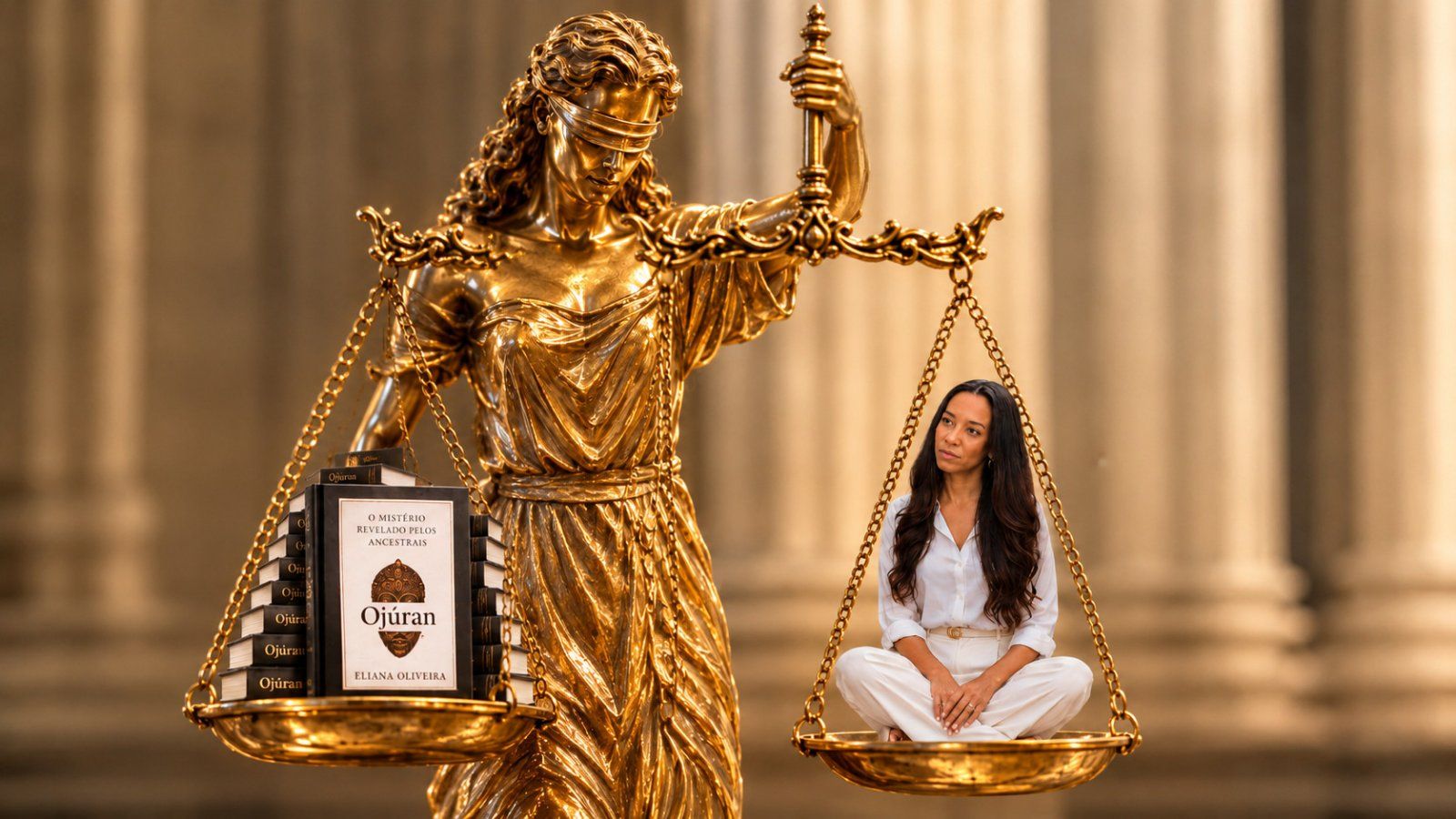
Image credit: Photograph of writer Eliana Oliveira: Brett W. The visual composition was developed with the assistance of artificial intelligence as an illustrative resource to accompany and represent the story.
FURTHER READING AND PUBLICATIONS
Links documenting the writer's professional journey and work related to Africa:
https://extra.globo.com/noticias/religiao-e-fe/pai-paulo-de-oxala/escritora-eliana-oliveira-lanca-livro-sobre-os-misterios-do-culto-ojuran-23267383.html
https://www.absoluterio.com.br/post/obra-oj%C3%BAran-o-mist%C3%A9rio-revelado-pelos-ancestrais?srsltid=AYCX9vIM3IZDb17Zhs3yO6nDP_mEBE-oJ4Vn8HnrMHAuRfRvXv-Oo0Zm
https://www.jornalacaradorio.com.br/2020/07/07/ojuran-o-misterio-revelado-pelos-ancestrais-livro-da-escritora-eliana-oliveira-que-penetra-fundo-nos-misterios-ocultos-dos-rituais-africanos/
https://senego.com/diaspora-eliana-oliveira-deconstruire-la-vision-de-cette-afrique-souffrante_1524154.html#google_vignette
PRESS CONTACT
Eliana Oliveira
Brazil
Email: lana3192@gmail.com