Links are not yet activated.
Is this your press release? Add a link to submitpr.org on your website and verify it — activation is instant and free.
Or upgrade with KIN for permanent activation (from $19.95).
A difficult bend rarely becomes easier by forcing the same tool to do a different job. In sheet metal fabrication, some components may look straightforward on a drawing, but producing that exact geometry can require a very different tooling approach. This is where press brake tooling becomes more than just a punch-and-die setup. The right tooling has to match the bend, the component geometry and the application.For standard bending operations, conventional tooling can handle a wide range of requirements. But when a job involves unusual profiles, offset bends or specific forming requirements, standard tooling may not always be the most suitable option. That is where specialized tooling comes into the picture.
Where Standard Tooling Falls Short
Not every component is designed around a conventional bend. A fabrication job may involve an offset, a particular profile, multiple bends or a geometry that requires the sheet to be positioned and formed in a specific way. In such cases, simply changing machine settings may not address the actual tooling requirement.
The tooling system plays a direct role in how the material is positioned and formed. Punches, dies, holders and inserts all have to work with the intended application. Factors such as the required bend geometry, tooling configuration and machine compatibility can influence which setup is appropriate.
This is why treating every bending application as a standard job can create unnecessary limitations. Instead of asking only whether the press brake can perform the operation, it is worth asking whether the tooling is designed for the operation you actually need to perform.
Why Special Press Brake Tools Matter
This is where special press brake tools can make a difference. Special tooling is developed for applications where conventional tooling may not provide the required geometry or setup. Rather than adapting the component to a standard tool, the tooling can be designed around the specific bending requirement.
This approach becomes particularly useful when manufacturers are dealing with non-standard profiles or specialized forming operations. The objective is not simply to create a different-looking tool. It is to provide a tooling solution that fits the application more appropriately.
For manufacturers, this can also mean looking beyond the tool itself and considering the complete setup. Tool material, hardness, dimensions, clamping arrangement and compatibility with the press brake system can all matter when precision and repeatability are important.
A well-designed tooling solution should therefore begin with the application — not with the assumption that one standard configuration will work for everything.
Understanding Z Offset Tooling
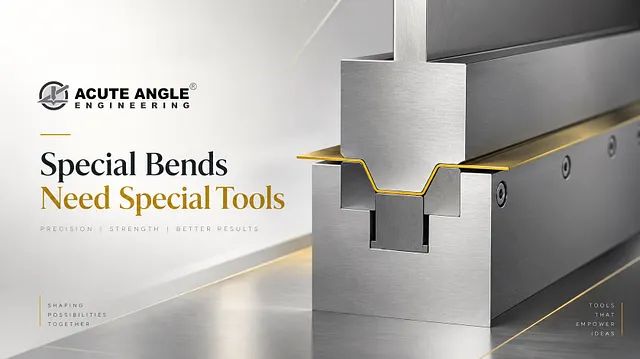
One example of a specialized requirement is an offset or Z-shaped bend. These applications may require tooling specifically designed to create the required change in profile while maintaining the intended dimensions and form.
This is where Z Offset Tool Inserts and Holders become relevant. Instead of relying solely on conventional tooling configurations, inserts and holders can be used as part of a specialized setup for particular offset-bending requirements.
The important point is that Z-offset tooling is not simply about adding another tool to the workshop. It is about matching the tooling geometry to the component that needs to be produced. The insert and holder arrangement becomes part of the solution for an application where a conventional setup may not be suitable.
For manufacturers handling varied sheet metal components, having access to specialized tooling can therefore provide another way to approach difficult bending requirements without treating every unusual geometry as a machine limitation.
Matching Tooling to the Application
The right press brake tooling starts with understanding the job. Before selecting a tool, manufacturers need to consider the required bend geometry, machine and tooling system, material, dimensions and the type of forming operation involved.
Acute Angle Engineering offers press brake tooling for systems including Amada, Trumpf, Wila, LVD and Bystronic, along with special tools and tooling modification services. Its press brake tooling range includes punches, dies and accessories in different configurations, with tool materials and heat-treatment specifications selected for the intended tooling requirements.
The bigger lesson is simple: difficult bending applications should not automatically be treated as difficult machine problems. Sometimes, the solution begins with looking more closely at the tooling.
When the geometry changes, the tooling approach may need to change with it. And for specialized applications, the right tool can be what turns a challenging bend into a practical manufacturing operation.
Have a Difficult Bend to Solve?
When standard tooling doesn’t fit the application, the right solution starts with understanding the bend. Acute Angle Engineering provides press brake tooling, special tools and customized tooling solutions for demanding bending requirements.
Discuss your application with our team and find the tooling solution that fits your job.