Links are not yet activated.
To activate, add a link back to submitpr.org from your website and contact @jaycosta on Telegram,
or pay via Solana (from $19.95) for instant activation.
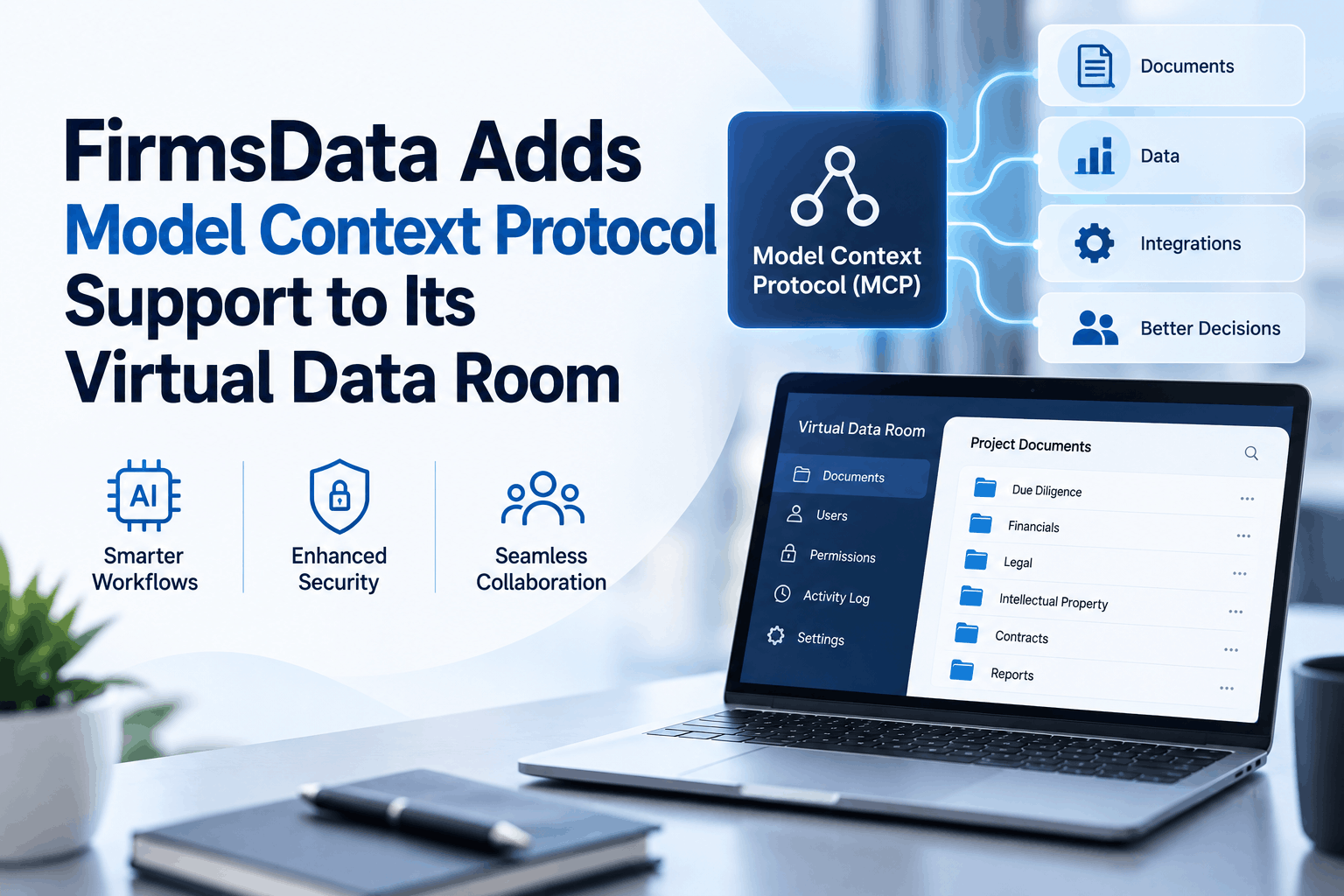
What MCP is, and why it matters here.MCP is an open standard for connecting AI assistants to the systems where data lives. Anthropic open-sourced it on November 25, 2024 (spec version 2024-11-05), and engineers David Soria Parra and Justin Spahr-Summers created it, per Anthropic's "Introducing the Model Context Protocol" announcement. On December 9, 2025, Anthropic donated MCP to the Agentic AI Foundation, which Anthropic described as "a directed fund under the Linux Foundation, co-founded by Anthropic, Block, and OpenAI, with support from Google, Microsoft, Amazon Web Services (AWS), Cloudflare, and Bloomberg." That move placed the protocol under neutral, community-driven governance.
Adoption is broad. By December 2025, Anthropic reported "more than 10,000 active public MCP servers" and adoption "by ChatGPT, Cursor, Gemini, Microsoft Copilot, Visual Studio Code, and other popular AI products," alongside over 97 million monthly SDK downloads. FirmsData chose MCP as its connection layer rather than a proprietary integration for a simple reason: portability. Users connect the assistant they already use, not one the vendor picks for them.
Setup.
Connection is self-serve. A user opens Settings, goes to MCP Keys, generates a key, copies one line of configuration, and connects in under a minute. A built-in "Test connection" button confirms the link works before the user leaves the screen. FirmsData ships ready-made setup for Claude Code, Claude Desktop, and Cursor, and works with any MCP-compatible assistant. For assistants that handle OAuth, automatic sign-in is supported, so users don't juggle keys.
Finding the right document.
In a large data room, the hard part is not reading a document. It is finding the right one. FirmsData Intelligent Search runs against document content, not just file names, across PDF, Word, Excel, and images. A keyword buried on page 140 still surfaces the file. Optical character recognition (OCR) is included, so scanned paper contracts are findable. The index stays in sync automatically as files are added, changed, or removed. If a workspace has not enabled Intelligent Search, the assistant falls back to name search, so it never breaks.
Intelligent Search is keyword and full-text search plus OCR. It returns file names that contain the searched text, not data extracted from inside the files. FirmsData returns the matching files, and the assistant then requests the ones it wants and reads them itself. FirmsData hands over a time-limited link to the original file, and only if that user is permitted to download originals. FirmsData does not ship parsed or converted copies of customer content through the AI interface. The division of labor is deliberate: FirmsData handles the finding and permission enforcement, and the assistant handles the reading and reasoning.
Analytics on demand for owners.
Workspace owners can ask for any report they want instead of being limited to a fixed dashboard. Example questions include which documents got the most attention this month, how to rank parties by engagement, what nobody has opened yet, how activity compares across three deals, and a request to summarize this week and flag anything unusual. The analytics cover the full activity feed: logins, views, downloads, watermarked downloads, uploads, document updates, redactions, NDA acceptances, and Q&A activity. Questions can span multiple workspaces, and activity data and documents can combine into a single conversation. No CSV exports, no separate business intelligence tool, and no feature request needed. For M&A and fundraising, buyer engagement is a genuine signal of intent, and owners can read it live.
Security and governance.
The MCP integration is read-only by design. It exposes a strict allow-list of actions, not a blanket API, and it doesn't expose authentication, single sign-on, or admin operations. Users see only what their existing permissions allow, including search results. Downloading an original requires the download-original permission, checked on each request; view access alone is not enough. Activity reporting is admin-only and verified live on every request.
No internal IDs are exposed. Identifiers are opaque and cannot be guessed or enumerated. Every AI action is logged, whether allowed, denied, or failed, with the user, the tool, and the document recorded. Analytics are privacy-conscious: users appear as opaque identifiers, with no IP or browser data exposed. Keys are stored hashed, shown once, support expiry, and can be revoked instantly. Download links are temporary and expire shortly after issuance.
The design keeps the AI coming to the data, not the other way around. Nothing is pre-copied into an AI vendor's index. This differs from approaches that send customer files out to a third-party vendor for processing. For InfoSec questionnaires and SOC 2 conversations, using AI this way strengthens the audit trail rather than weakening it.
Learn more about FirmsData: https://firmsdata.com/