Links are not yet activated.
Is this your press release? Add a link to submitpr.org on your website and verify it — activation is instant and free.
Or upgrade once for permanent activation (from $19.95, pay with crypto).
What Is an Asbestos Ceiling?An asbestos ceiling is a ceiling that contains asbestos in one or more of its building materials or surface coatings.
Asbestos was historically used in construction because of its strength, durability, heat resistance, and insulating properties. It could be incorporated into different building products, including cement sheets, ceiling panels, insulation materials, and decorative textured coatings.
In older properties, asbestos may be present in:
Textured or popcorn-style ceiling coatings
Some older plasterboard and ceiling products
Ceiling panels and fibre-cement sheets
Insulation materials above ceilings
Certain decorative finishes and joint compounds
Not every old ceiling contains asbestos. The material, installation date, manufacturer, and condition all influence the likelihood of asbestos being present.
AR Plus specifically highlights ceilings installed or coated before 1990, particularly textured ceilings, as materials that may require asbestos testing before restoration work begins.
Why Was Asbestos Used in Ceiling Materials?
Asbestos was widely incorporated into construction products during the twentieth century. Manufacturers used it because it offered several properties that were useful in building applications.
These included:
Heat resistance: Asbestos fibres could withstand high temperatures, making them useful in certain insulation and building products.
Durability: Asbestos-containing materials were valued for their strength and resistance to wear.
Fire resistance: Some asbestos products helped improve the fire-resistant properties of building materials.
Insulation: Asbestos was used in products designed to provide thermal and acoustic insulation.
Although these properties made asbestos attractive to manufacturers, its health risks are now well established. When asbestos-containing materials are damaged or disturbed, fibres can become airborne and may be inhaled.
How to Identify a Possible Asbestos Ceiling
It is not possible to confirm asbestos simply by looking at a ceiling. However, certain characteristics may indicate that professional testing is appropriate.
1. Popcorn or Textured Ceiling Finishes
One of the most commonly discussed ceiling types is the popcorn ceiling. It has a rough, raised, or stippled appearance created by applying a textured coating to the ceiling surface.
Some older textured coatings contained asbestos, particularly those installed before the 1990s.
However, many textured ceilings do not contain asbestos. The appearance alone cannot confirm the material's composition.
2. Older Ceiling Installation
The age of a building can provide useful background information when assessing asbestos risk.
Properties constructed or renovated before asbestos restrictions may contain asbestos-containing materials in ceilings, walls, roofing, and other building components.
AR Plus recommends testing ceilings installed or coated before 1990, especially where textured finishes are present.
3. Damaged or Deteriorating Surfaces
Cracks, peeling, bubbling, sagging, and damaged ceiling sections should be assessed carefully.
These signs do not necessarily indicate asbestos. They may result from water leaks, ageing, poor installation, or movement in the building structure.
However, if an older ceiling contains suspected asbestos, damaging or disturbing the material can create unnecessary exposure risks.
4. Previous Renovations
Earlier renovation work may have covered, repaired, or altered older ceiling materials without completely removing them.
If you do not know what materials were used, an asbestos survey can help establish whether asbestos is present before further work begins.
Is an Asbestos Ceiling Dangerous?
The health risk associated with asbestos depends largely on whether fibres are released into the air and inhaled.
Asbestos-containing materials that remain in good condition and are left undisturbed may present a lower immediate risk than damaged or deteriorating materials.
The concern increases when asbestos-containing materials are:
Sanded or scraped
Drilled or cut
Broken or crushed
Removed without appropriate controls
Damaged during renovations or demolition
Once airborne, asbestos fibres can be inhaled and become lodged in the lungs. Exposure is associated with serious diseases, including mesothelioma, lung cancer, and asbestosis.
These conditions may take many years to develop after exposure.
For this reason, property owners should not attempt to investigate a suspected asbestos ceiling by scraping the surface, collecting samples, or breaking off pieces themselves.
If you suspect asbestos, avoid disturbing the area and arrange professional advice and testing.
What Should You Do If You Suspect Asbestos in Your Ceiling?
Discovering a potentially asbestos-containing ceiling can be concerning, especially if you are planning renovations or have noticed damage.
The safest approach is to avoid disturbing the material until its composition has been established.
Follow these steps:
Step 1: Avoid Touching or Disturbing the Ceiling
Do not scrape, sand, drill, cut, or remove the suspected material.
Avoid activities that could create dust or damage the ceiling surface.
Step 2: Restrict Access if the Material Is Damaged
If the ceiling is visibly damaged or debris is present, keep people away from the affected area.
Do not attempt to clean suspected asbestos dust using an ordinary household vacuum or dry sweeping.
Step 3: Arrange Professional Asbestos Testing
A qualified professional can assess the material and arrange appropriate sampling and laboratory analysis.
Testing helps establish whether asbestos is present and supports decisions about whether the material can remain undisturbed or requires removal.
Step 4: Obtain a Removal or Management Plan
If asbestos is confirmed, the next step depends on the material's condition, location, and the proposed building work.
A professional can explain whether management, encapsulation, or licensed removal is appropriate.
Step 5: Complete Restoration After Necessary Clearance
If removal is required, the affected ceiling can be repaired or replaced after the relevant safety and clearance requirements have been satisfied.
This may involve plasterboard installation, stopping, sanding, sealing, repainting, and optional decorative finishing.
Asbestos Ceiling Removal: What Does the Process Involve?
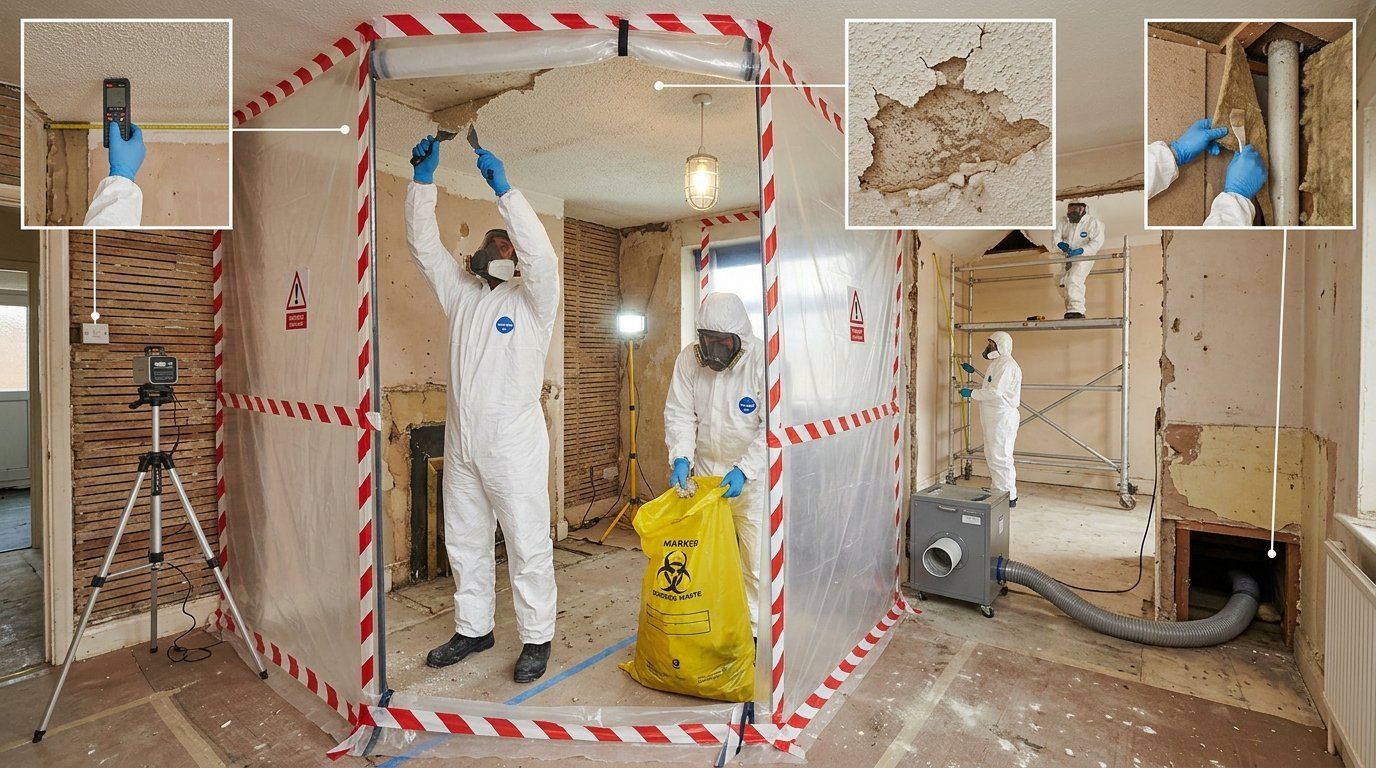
Removing asbestos-containing ceiling materials requires careful planning and appropriate safety controls.
The exact process depends on whether the material is bonded or friable, how much needs to be removed, and the condition and accessibility of the ceiling.
AR Plus provides licensed asbestos removal services and describes a structured approach to assessing, removing, and managing asbestos-containing materials.
1. Initial Assessment and Testing
The first stage is to establish what materials are present and determine the scope of the work.
An asbestos survey or laboratory test may be required to confirm whether the ceiling coating or underlying material contains asbestos.
This information helps the contractor identify the appropriate removal method and safety requirements.
2. Removal Planning and Containment
Before work begins, the removal contractor develops an appropriate plan and prepares the work area.
Depending on the project, this may involve isolating the affected space, installing containment, using protective equipment, and establishing suitable controls to prevent fibre release.
3. Licensed Asbestos Removal
The removal work must be carried out by an appropriately licensed contractor when required under New Zealand regulations.
AR Plus holds Class A and Class B asbestos removal licences, allowing it to undertake different categories of asbestos removal within the scope of those licences.
The removal method depends on the type and condition of the asbestos-containing material.
4. Waste Handling and Disposal
Asbestos waste must be packaged, transported, and disposed of in accordance with applicable requirements.
It cannot simply be mixed with ordinary household rubbish or placed in an unsuitable waste facility.
Professional removal contractors manage the required waste-handling arrangements as part of the project.
5. Cleaning and Independent Clearance
After removal, the work area needs appropriate cleaning and decontamination.
Where required, an independent licensed asbestos assessor undertakes clearance inspections to determine whether the area meets the applicable clearance requirements.
AR Plus describes independent post-removal clearance inspection and reporting as part of its asbestos removal process.
Only after the required clearance arrangements have been completed should the next stage of restoration proceed.
Can You Remove an Asbestos Popcorn Ceiling Without Replacing the Entire Ceiling?
In some cases, yes.
Removing a popcorn-style coating does not always mean that the entire ceiling needs to be replaced. The best approach depends on the condition of the underlying ceiling and the nature of the asbestos-containing material.
AR Plus explains that popcorn ceiling removal can often be completed without replacing the whole ceiling. Depending on the condition, the existing surface may be stripped, repaired, and resurfaced to create a smoother, more modern finish.
However, if the underlying plasterboard is damaged, poorly fixed, sagging, or extensively water-affected, replacing some or all of the ceiling may be more effective.
The important first step is professional asbestos assessment. Suspected asbestos-containing coatings should never be scraped or sanded as a DIY project.
Ceiling Restoration After Asbestos Removal
Once asbestos removal and the required clearance process have been completed, the ceiling may need further work to restore its appearance and functionality.
This is where professional ceiling restoration becomes important.
AR Plus offers residential and commercial ceiling restoration, including repairs, resurfacing, plastering, and repainting.
Plasterboard Repairs and Replacement
If the existing ceiling has damaged or unsuitable sections, plasterboard may need to be repaired or replaced.
The decision depends on the extent of the damage, the condition of the framing, and the requirements of the finished space.
Gib Fixing and Stopping
Gib fixing and stopping help create a smooth surface ready for painting.
Modern fixing methods use a combination of adhesive and screws, helping provide a more secure installation than older nail-only methods.
Skim Coating and Resurfacing
Skim coating can improve the appearance of an uneven or previously repaired ceiling.
It involves preparing the surface and applying a finishing layer to achieve a smoother result.
Sealing and Repainting
After repairs and surface preparation, the ceiling can be sealed and repainted using suitable ceiling paint.
Professional preparation helps create a more consistent finish and reduces the appearance of patch repairs, joint lines, and surface imperfections.
Optional GIB Cove Installation
AR Plus also offers optional GIB Cove installation during ceiling restoration.
GIB Cove provides a clean finishing detail between walls and ceilings and can be used as an alternative to traditional cornices or square-set finishes.
Different profiles are available to suit modern and traditional interior styles.
Other Ceiling Problems That May Require Professional Restoration
Not every damaged ceiling contains asbestos. Many ceiling issues result from moisture, ageing, movement, and previous installation problems.
AR Plus provides restoration services for a variety of ceiling conditions.
Sagging Ceilings
Ceilings may sag because of moisture damage, movement in the framing, disturbed insulation, or older fixing methods.
A proper assessment helps identify the cause before repairs are recommended.
Cracked Plasterboard
Cracks may develop where ceiling materials move, joints deteriorate, or the building structure experiences movement.
Depending on the severity, repairs may involve refixing, joint treatment, resurfacing, or replacement.
Water-Damaged Ceilings
Leaks, burst pipes, and storm damage can leave ceiling surfaces stained, weakened, or damaged.
If plasterboard is beyond repair, affected sections may need to be replaced before finishing and repainting.
Mould-Stained Areas
Moisture problems can encourage mould growth on ceilings.
Before restoration, the source of moisture should be investigated and addressed. Covering visible mould with paint alone does not resolve the underlying problem.
Outdated Textured Finishes
Older stippled and popcorn-style finishes can make interiors look dated.
Where asbestos is not present, suitable restoration methods can help create a smoother and more contemporary ceiling. If asbestos is suspected, professional testing must come first.
Why Choose AR Plus for Asbestos Ceiling Removal and Restoration?
Choosing a contractor for asbestos-related ceiling work requires more than comparing prices. Licensing, safety procedures, experience, and the quality of restoration work should all be considered.
AR Plus has been operating since 1995 and provides asbestos removal, ceiling restoration, plastering, and painting services for residential and commercial properties.
Its services offer several advantages for property owners.
Licensed Asbestos Removal
AR Plus holds Class A and Class B asbestos removal licences, enabling the company to undertake different categories of asbestos removal work within the scope of its licences.
Combined Removal and Restoration Services
The company offers asbestos testing and removal alongside plastering, resurfacing, ceiling repairs, and painting.
This can make project coordination easier when a ceiling needs both hazardous-material removal and subsequent restoration.
Residential and Commercial Experience
AR Plus works with homeowners, property managers, builders, project managers, business owners, and facility managers.
Its approach can be adapted to individual rooms, rental properties, offices, and larger commercial spaces.
Modern Materials and Fixing Methods
Where ceiling replacement is required, AR Plus uses modern plasterboard options and fixing methods.
Depending on the space, these can include thicker boards, moisture-resistant products, fire-rated plasterboard, and acoustic-rated panels.
Careful Work in Occupied Properties
The company highlights tidy and respectful work practices, including protecting floors, furniture, and equipment during restoration.
This is particularly important when working in occupied homes, rental properties, and operational commercial buildings.
How Much Does Asbestos Ceiling Removal Cost?
The cost of asbestos ceiling removal depends on several project-specific factors.
These may include:
The total ceiling area
Whether the material is bonded or friable
The condition of the ceiling
Accessibility and working height
Testing and assessment requirements
Containment and safety controls
Waste transport and disposal
Independent clearance requirements
Whether plastering and painting are needed afterwards
A small ceiling area may require a different approach from a large commercial ceiling or an entire residential property.
AR Plus provides project assessments and no-obligation quotes rather than applying one fixed price to every job.
Property owners can also discuss whether they need removal only or a complete service that includes ceiling restoration and repainting.
Where Does AR Plus Provide Ceiling Restoration Services?
AR Plus operates across the central North Island, serving residential and commercial customers in several regions.
Its listed office locations include:
Tauranga: 32 Whiore Avenue, Tauriko, Tauranga 3110.
Hamilton: 526 Victoria Street, Hamilton 3204.
Rotorua: 98 Old Taupo Road, Mangakakahi, Rotorua 3015.
Napier: 7a Tangaroa Street, Ahuriri, Napier 4110.
If you are located outside these areas, contact the team to confirm whether your project falls within its service coverage.
Frequently Asked Questions About Asbestos Ceilings
1. How do I know if my ceiling contains asbestos?
You cannot reliably identify asbestos by appearance alone. Older ceilings, particularly textured or popcorn-style finishes installed before 1990, may contain asbestos. Professional sampling and laboratory testing are the appropriate ways to confirm its presence.
2. Are all popcorn ceilings made with asbestos?
No. Many popcorn ceilings do not contain asbestos. However, some older textured coatings may contain asbestos, so professional testing is recommended before scraping, sanding, drilling, or removing them.
3. Is it safe to live in a house with an asbestos ceiling?
An asbestos-containing ceiling in good condition that remains undisturbed may present a lower immediate risk than damaged or deteriorating material. The condition of the ceiling and the possibility of fibre release should be assessed by a qualified professional.
4. Can I paint over an asbestos ceiling?
Painting or sealing may be considered as part of an appropriate asbestos management approach in some circumstances. However, the correct method depends on the material's condition and professional assessment. Do not sand, scrape, or prepare suspected asbestos-containing surfaces yourself.
5. Should I replace an asbestos ceiling or remove only the textured coating?
The decision depends on the condition of the existing ceiling, the asbestos-containing material, and the intended finish. In some cases, the textured coating can be removed and the existing ceiling resurfaced. In others, replacing damaged sections or the entire ceiling may be more appropriate.
6. Does AR Plus provide asbestos testing and ceiling restoration?
Yes. AR Plus provides asbestos testing and removal services alongside ceiling restoration, plastering, resurfacing, and repainting. This allows property owners to discuss the different stages of their project with one provider.
7. Can AR Plus repair a ceiling after water damage?
Yes. AR Plus restores ceilings affected by leaks, burst pipes, and storm damage. Depending on the condition, the work may involve repairing or replacing plasterboard, stopping, sanding, sealing, and repainting.
Final Thoughts
An older textured ceiling should not automatically be assumed to contain asbestos, but it should be treated carefully until its composition is confirmed. Disturbing suspected asbestos-containing materials through scraping, sanding, drilling, or DIY removal can release harmful fibres and create unnecessary health risks.
Professional testing helps establish whether asbestos is present and whether management or licensed removal is required. Once the necessary safety and clearance procedures are complete, ceiling restoration can address damaged surfaces, improve appearance, and create a smooth, modern finish.
AR Plus provides asbestos testing, licensed removal, popcorn ceiling services, and complete ceiling restoration for residential and commercial properties across the central North Island.
If you are concerned about an older ceiling or planning a renovation, visit AR Plus Ceiling Restoration to explore its services, arrange a site assessment, and request a free, no-obligation quote.
Visit : https://www.arplus.nz/ceiling-restorations/