Links are not yet activated.
To activate, add a link back to submitpr.org from your website and contact @jaycosta on Telegram,
or pay via Solana (from $19.95) for instant activation.
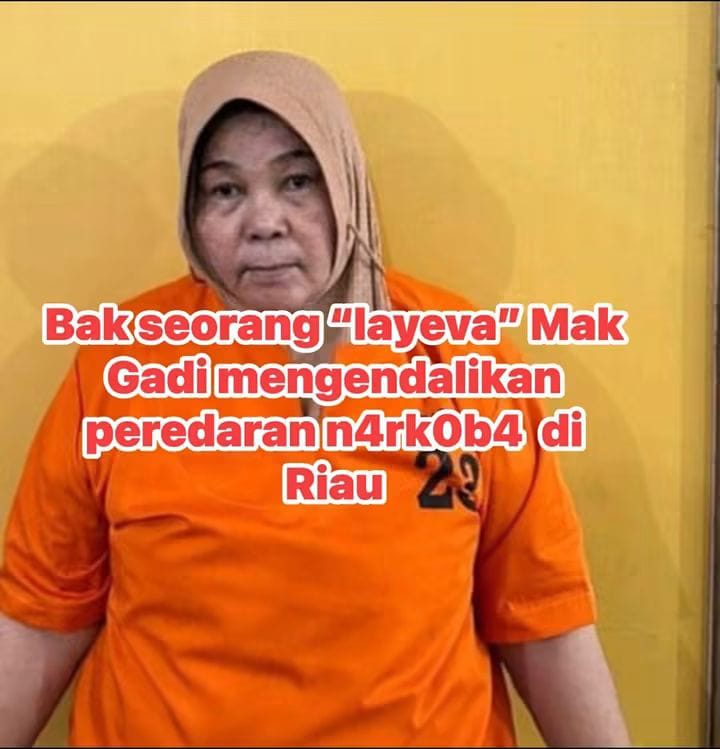
INDRAGIRI HULU, RIAU, INDONESIA — September 23, 2026 — A woman known locally as **“Mak Gadi,” identified in information received by this publication as Hajjah Nurhasanah, born in Rengat, Riau, in July 1959, is alleged to have been involved in the illicit narcotics trade in Indragiri Hulu for decades.According to information received by the media, Nurhasanah allegedly became involved in narcotics distribution in the 1990s while her husband was still alive. Following his death, she is alleged to have continued the operation and assumed a more prominent role within the network.
The allegations have not been established in court, and this publication has not independently verified all of the claims.
Alleged Operations From a Family Compound
Information obtained by this publication indicates that Nurhasanah and several adult children are believed to live in a large family compound in the Pasir Jaya Raya area of Kuantan Babu Village, Rengat, Indragiri Hulu.
The compound is reportedly made up of a main residence occupied by Nurhasanah and several other houses occupied by members of her family and their respective partners.
The location is also reportedly equipped with closed-circuit television cameras. According to the information received, the surveillance system is allegedly used to monitor movements around the compound.
These claims require verification through law-enforcement records, witness testimony, physical evidence and other independently corroborated sources.
Indonesia Faces a Major Narcotics Challenge
The allegations come amid extensive official data showing that Indonesia continues to face a significant narcotics problem.
The National Narcotics Agency of Indonesia (BNN) reported that in 2025 it uncovered 746 narcotics and precursor cases, dismantled 42 organized trafficking networks — including 33 national and nine international networks — and arrested 1,174 suspects. Authorities seized approximately 4.01 tonnes of methamphetamine, 2.17 tonnes of cannabis and other narcotics.
Police figures also illustrate the scale of the problem. Between January and October 2025, the Indonesian National Police and regional police reportedly uncovered 38,934 narcotics cases and arrested 51,763 suspects, with seizures totaling approximately 197.71 tonnes of narcotics and related substances.
BNN has also cited an estimated narcotics circulation value of approximately Rp500 trillion per year and reported a 2025 prevalence figure of 2.11 percent, equivalent to around 4.1 million people exposed to narcotics, according to figures presented by the agency in January 2026.
Allegations of Protection by Officials
One of the most serious questions raised by allegations surrounding narcotics networks in Indonesia is whether individual officials or other insiders may provide protection to criminal organizations.
There is documented evidence that law-enforcement and detention personnel have been implicated in individual narcotics cases. In January 2025, BNN reported a joint operation that uncovered 11 narcotics cases involving 44 suspects, including prisoners and detention-facility personnel.
Such cases demonstrate why allegations concerning possible official protection require independent investigation. However, evidence of misconduct involving particular individuals should not automatically be interpreted as evidence that the Indonesian Government or law-enforcement institutions as a whole are protecting narcotics syndicates.
Enforcement Efforts Continue
Contrary to claims that Indonesian authorities have taken no action, official records show substantial enforcement operations.
In May 2026, BNN reported an operation covering several Indonesian provinces, including Riau and the Riau Islands, which resulted in 31 arrests and the seizure of approximately 136.5 kilograms of methamphetamine, 147 kilograms of cannabis, ketamine and thousands of ecstasy tablets.
BNN also reported that during June and July 2025, authorities uncovered 84 narcotics cases and arrested 136 suspects, seizing more than 561 kilograms of narcotics.
The official record therefore points to significant enforcement activity, while the continued scale of trafficking raises questions about whether enforcement is sufficient to disrupt the networks at their highest levels.
The Questions That Remain
The allegations surrounding Mak Gadi raise several questions that can only be answered through a transparent investigation:
* Who allegedly supplies the narcotics?
* Where does the money from the alleged operation go?
* Who are the alleged distributors and intermediaries?
* Are there financial assets connected to the suspected network?
* Have any officials or other insiders provided protection or information to traffickers?
* Have previous complaints or intelligence reports concerning the alleged operation been investigated?
* Are there links between local networks and larger national or international trafficking organizations?
These questions should be addressed through evidence rather than assumptions.
If law-enforcement authorities receive credible information concerning an alleged narcotics network, an investigation should establish the facts, identify those responsible and determine whether any individuals inside or outside government have unlawfully assisted the operation.
A Case Requiring Independent Verification
At present, the allegations concerning Nurhasanah alias Mak Gadi should be treated as unproven allegations, not established criminal findings.
This publication has not established through an independent court record that Nurhasanah is a narcotics trafficker, nor has it independently confirmed the alleged structure of the network described by sources.
Nurhasanah and any other persons named in connection with these allegations should be given an opportunity to respond, and any law-enforcement investigation should follow due process and applicable Indonesian law.
The broader issue, however, is documented: Indonesia continues to face extensive narcotics trafficking, while authorities themselves report thousands of cases, large seizures and the existence of organized national and international networks.
The central question for investigators is therefore not simply whether narcotics trafficking exists, but whether enforcement can consistently reach the financial networks, organizers, facilitators and any individuals who may unlawfully protect them.